The honest situation
São Conrado has almost no restaurant strip. There is no equivalent of Ipanema's Rua Garcia d'Ávila or Leblon's Dias Ferreira here — the neighbourhood is residential, the flat land is mostly golf course, and the commercial fabric is thin. This is the cost of the quiet, and it is the one thing visitors reliably underestimate.
What São Conrado does have is three tiers of option, each about a car journey apart: the hotel restaurants on Avenida Niemeyer, five minutes away; Baixo Gávea up over the hill, about ten; and Leblon and Ipanema along the cliff road, about fifteen. In practice a week here means a couple of nights out and the rest at the house with a cook, which is a better ratio than it sounds.
Restaurant scenes move faster than any guide, and Rio's moves fast. Treat the names below as orientation — the concierge books current tables and will tell you what has closed, changed hands, or stopped being worth it.
In the neighbourhood: Avenida Niemeyer
The best eating actually inside São Conrado is at the hotels on the cliff road, and it is better than that sounds because of where they sit.
The Hotel Nacional at Avenida Niemeyer 769 is the Oscar Niemeyer tower described in the neighbourhood's history — inaugurated in 1972, closed for over twenty years, reopened in December 2016. Its restaurant, Masi, is at the top of the tower on the thirtieth floor, which gives you the whole coast through glass. Going for dinner is the simplest way to get inside a protected piece of Brazilian modernism, and the Burle Marx gardens are on the way in.
Further east along the same road, at Avenida Niemeyer 121 in Vidigal, the Sheraton Grand Rio has several restaurants: L'Etoile, which is French with a panoramic ocean view, the more casual Casarão, and Mirador, which does a feijoada every Saturday. A Saturday feijoada in Rio is a proper institution and a long lunch rather than a meal — if your stay includes a Saturday, it is a good use of one.
On the beach itself there are kiosks rather than restaurants: a coconut, a beer, grilled things, the usual vendors. Good for a beach afternoon, not an evening. The Fashion Mall next door has food and a cinema and is convenient rather than a destination; it was Rio's luxury shopping address in the 1980s and is much diminished, though new tenants keep arriving.
Up the hill: Baixo Gávea
Drive up through the Zuzu Angel tunnel and you are in Gávea in about ten minutes, and this is where the neighbourhood's real casual eating lives. The corner known as Baixo Gávea, around Praça Santos Dumont, is a genuine Rio night-out place — busy, loud, unpretentious, students and families and people who have been coming for decades.
Braseiro da Gávea at Praça Santos Dumont 116 is the fixture. Simple room, honest food, and picanha ao braseiro as the dish everyone orders — served with rice, farofa and the rest, in quantities designed for sharing. It runs late: roughly midday to one in the morning, and to three at weekends. It is not a fine-dining evening and is not trying to be; it is the thing to do when a group wants dinner without ceremony.
Gávea more broadly has a cluster of neighbourhood restaurants of exactly this kind, plus the Jockey Club and the botanical garden nearby for the daytime. If you want one evening that feels like Rio rather than like a hotel, this is the closest place to get it.
Fifteen minutes east: Leblon and Ipanema
This is where Rio's serious restaurants are, and the drive along Avenida Niemeyer to get there is one of the better commutes in the world — cliff on one side, ocean below, Leblon appearing around the corner. Fifteen minutes without traffic, more at rush hour, and a driver makes the whole thing effortless because parking in Leblon on a Friday is its own small ordeal.
Leblon is the more grown-up of the two: contemporary Brazilian cooking, good seafood, serious wine lists, and a concentration of the city's best-regarded kitchens within a few blocks. Ipanema is broader and more social, with everything from long-standing institutions to whatever opened last month, and it is where you go if the group wants to eat and then be out rather than eat and then leave.
Two practical notes for a group of ten. Book ahead — a party of ten is not a walk-in anywhere good in the South Zone, and on Friday or Saturday it is a week's notice, more in high season. And ask for one table rather than two; restaurants will sometimes split a large party across the room without mentioning it, which quietly ruins the point of everyone going out together.
How Rio actually eats
Dinner is late. Eight is early, nine is normal, and a restaurant that looks empty at half past seven will be full at ten. Lunch is the larger meal for many cariocas, and long lunches are a genuine institution rather than an indulgence.
A service charge of around ten per cent is normally added to the bill. It is customary rather than legally compulsory, and it is standard practice to pay it. Cards are accepted almost everywhere; carry a little cash for beach kiosks.
Feijoada is a Saturday thing, traditionally, and it is a heavy midday meal rather than a dinner — plan the afternoon accordingly. Churrasco, the other set-piece, is best approached hungry and slowly; the rodízio format keeps arriving until you turn the card over.
Juice bars are one of Rio's real pleasures and are everywhere, including in Leblon and Ipanema. Order things you cannot get at home — açaí properly made, graviola, cajá, açerola — rather than orange juice.
And the option most groups actually use
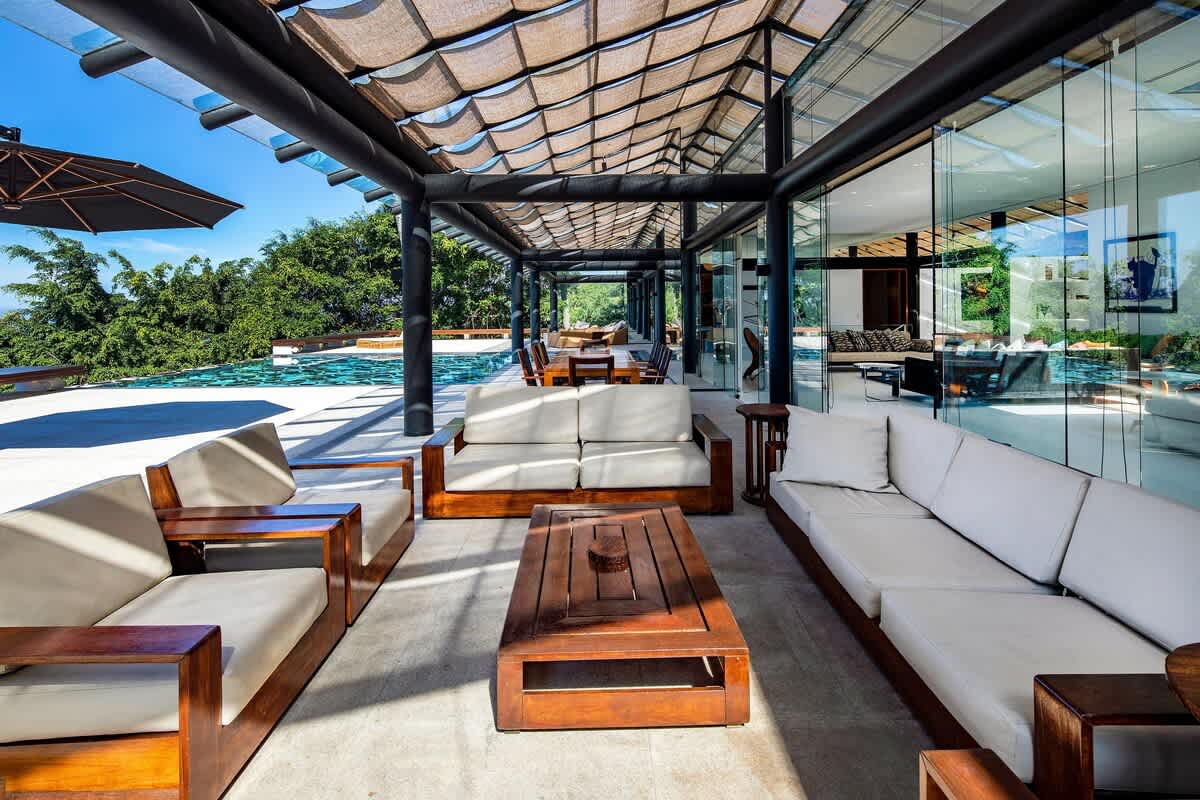
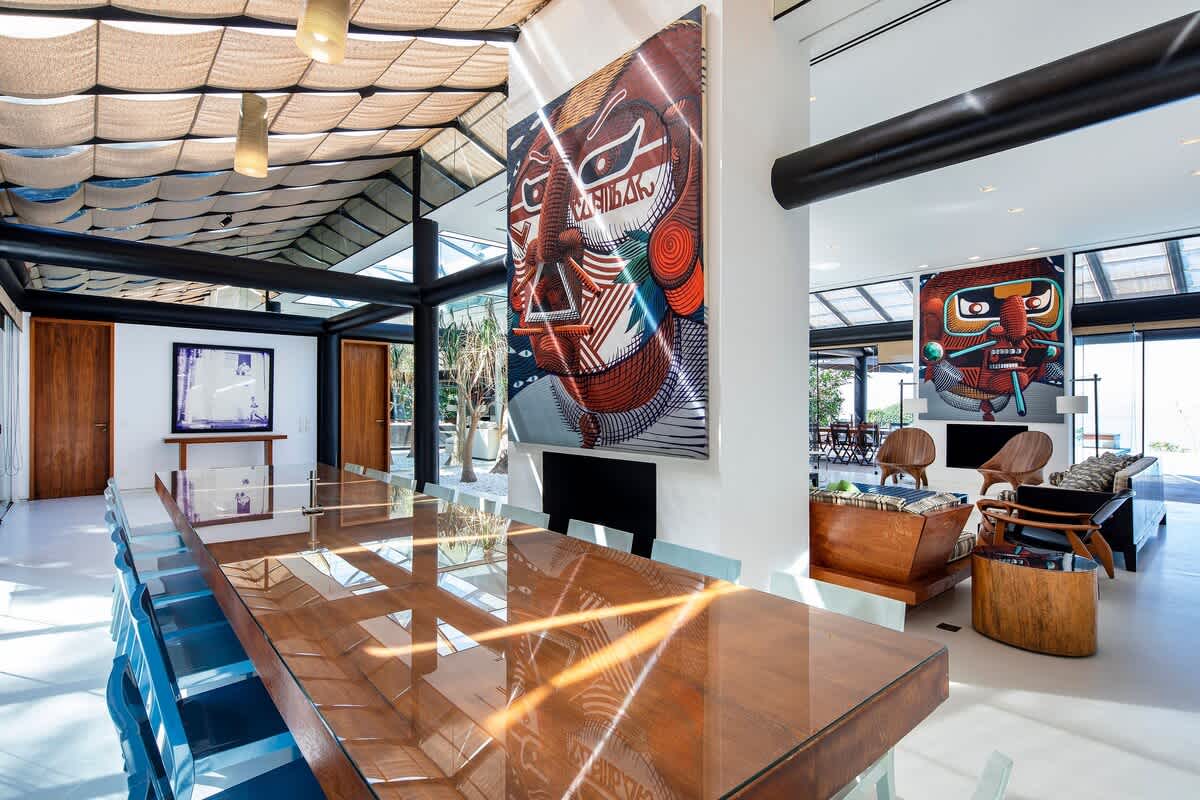
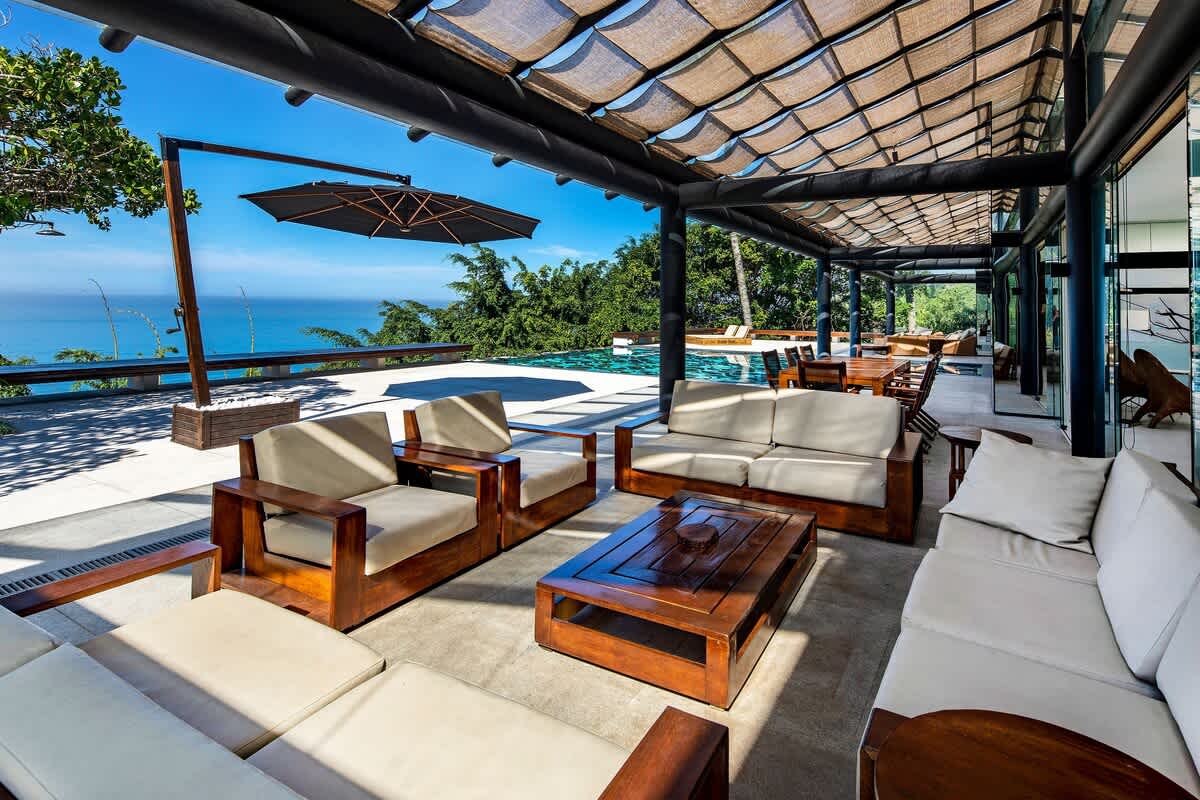
With a cook at the house, the calculation changes. Breakfast happens on the terrace without anyone organising it, lunch by the pool is a matter of asking, and dinner is at the long table with the coast going dark in front of you. For a group of ten, that removes the two hardest things about eating out in Rio — the booking and the getting back up the hill afterwards.
The cook shops for the house, so send preferences and restrictions when you book rather than on arrival: what the children eat, what nobody drinks, allergies as distinct from dislikes. Fish and seafood are the obvious strength here, and a cook who knows the local market will do better with what came in that morning than with a menu you wrote in advance.
The pattern that works is simple. Eat at the house most nights, go out twice — one long lunch, one dinner in Leblon — and put a Saturday feijoada somewhere in the middle. Dinner at the villa describes how an evening here tends to run, and the concierge books the nights you do want out.
Send us the nights you want to be out and the nights you'd rather not move, and the cook and the concierge will build the week around it.