Reserve direct
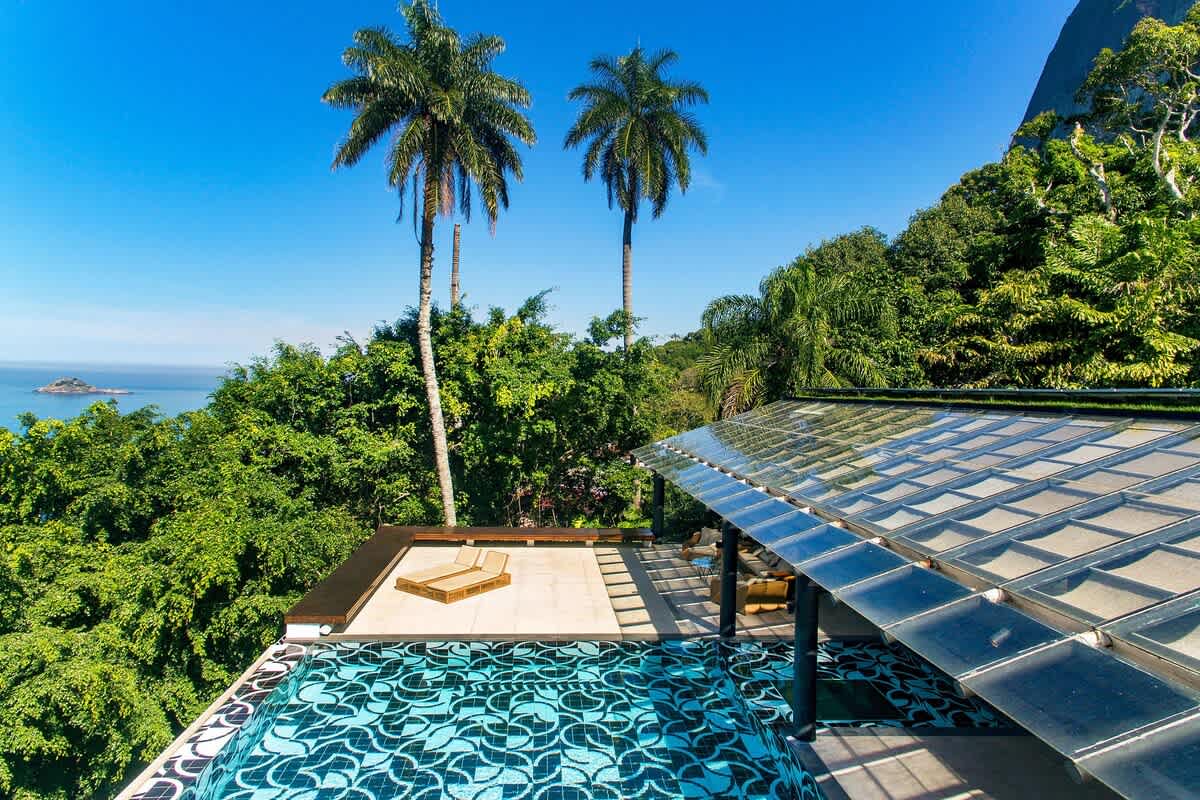
We run a five-suite villa with an infinity pool above São Conrado beach, and its rates and live availability are on the Art de Vivre booking page.
Book directGetting there
Búzios is about 190 km east of São Conrado by road, a drive of around three hours that can stretch on summer weekends and holidays. The route takes the Linha Amarela across the city, crosses the Rio-Niterói Bridge, runs along the BR-101 and then the Via Lagos, a toll road, before the Estrada dos Búzios carries you out onto the peninsula.
With a group, the villa's English-speaking driver, arranged through Art de Vivre's concierge, is the easy way to do it, and nobody has to take the wheel after a long day in the sun. It is a long round trip for a single day, so a night or two works better: book a night nearby and come back the next afternoon.
If you drive yourselves, the Via Lagos runs 56 km between Rio Bonito and São Pedro da Aldeia, and parking in the centre of Búzios fills quickly in high season, when private car parks charge more. The town also has a small airport, Umberto Modiano, used by general aviation. There is more on drivers and rental cars in getting to Rio and around.
A short history
By the middle of the 1600s Búzios was a fishing village of about twenty houses. In 1740 Brás de Pina set up a whaling station here that ran for fifty years, and its whale oil was used to light Rio. The bones of the whales were buried on the beach next to the Praia da Armação, which is why it is still called Praia dos Ossos, the beach of bones.
Older layers of the story are still on the map. On Manguinhos beach there is a stone pier built by enslaved people, and the Rasa neighbourhood began as a settlement founded by freed people after abolition in 1888.
Modern Búzios began with a film star. In January 1964 the French actress Brigitte Bardot arrived with her boyfriend, the Brazilian-Moroccan Bob Zagury, and stayed for four months, until April. She came back for a shorter stay from December 1964 into January 1965.
Her visits carried the name of Búzios around the world, and Rio's high society soon followed. The village split from Cabo Frio to become its own municipality on 12 November 1995, and about 40,000 people live here today. Bardot died in December 2025, aged 91, and the town still carries her name on its waterfront.
Rua das Pedras and the Orla Bardot
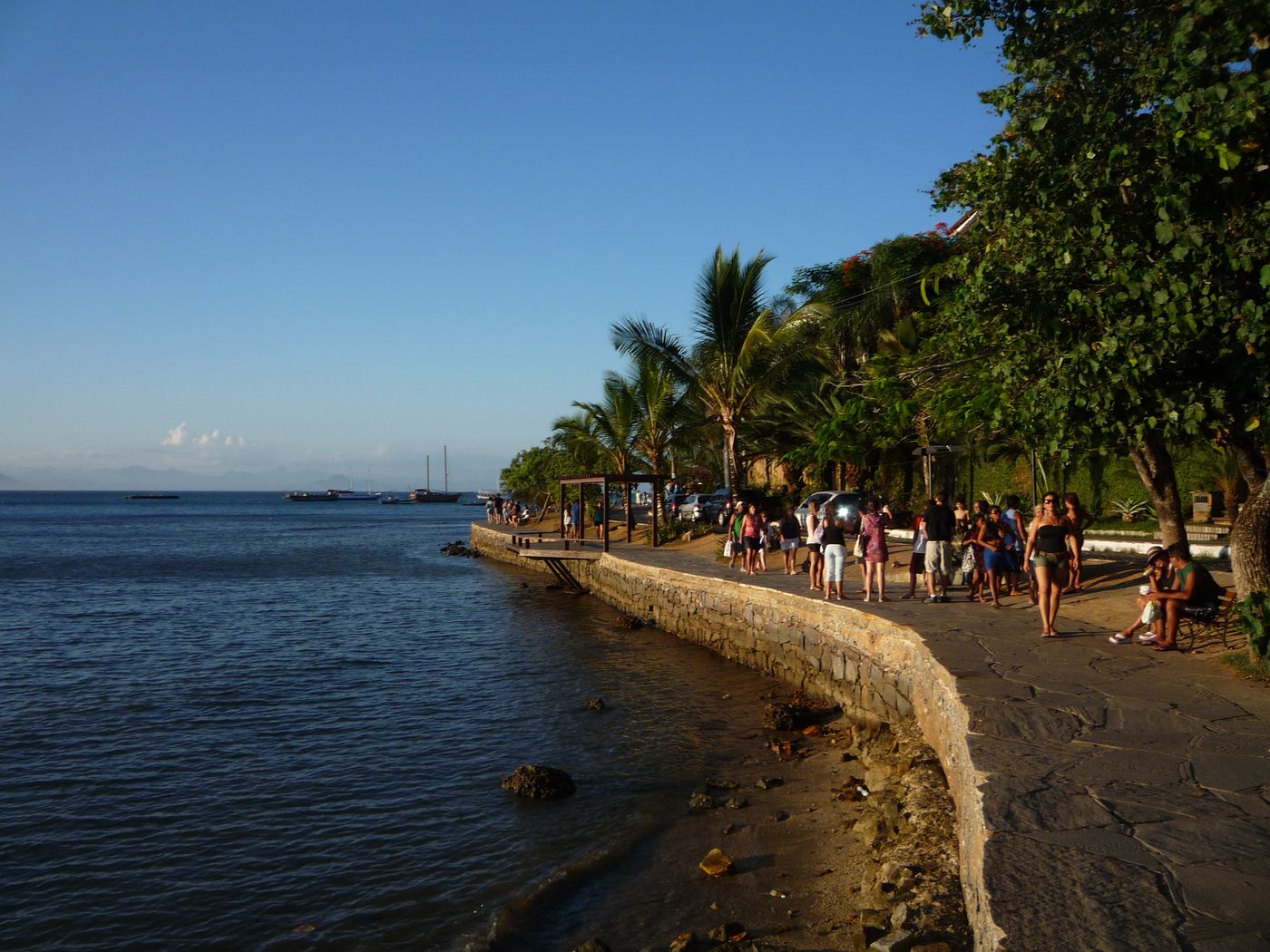
Rua das Pedras is the main street of the town, with bars, restaurants and shops, and it is where Búzios goes out at night. On her return visit in December 1964, Bardot spent Christmas in a family house on this street. The Orla Bardot, the waterfront promenade beside it, is named after her, and since 1999 it has had a bronze statue of the actress by the sculptor Christina Motta.
Praia da Armação and Praia dos Ossos, a short walk away, are the boat beaches. Boats moor in the bay, so swim elsewhere, but come back at the end of the day: the schooners and water taxis leave from here, and the Armação waterfront is a good place to watch the sun go down.
Evenings are for a slow stroll along Rua das Pedras and the waterfront, then dinner at one of the restaurants along the way. The driver can drop you in the centre and collect you when you are ready.
Geribá and Ferradura
The peninsula runs for about 8 km and has 23 beaches. Some are sheltered coves with calm, clear water, while the ones facing the open sea are wilder and draw the surfers.
Geribá is one of the best known, almost 2 km of sand with kiosks along it and waves that suit surfing and windsurfing. The beach is so wide that it rarely feels full. The right-hand end is the quietest, the middle the liveliest, and the left-hand end has calmer water.
From that left corner a path leads on foot to Ferradurinha, a small cove between two rock walls with very calm water inside, good for children, paddleboards and kayaks. It is small and fills up at weekends, so go early.
Ferradura is named after its horseshoe shape, which keeps the water calm. It suits families, with some shade and a few restaurants, and the bay is used for stand-up paddleboarding, kayaking and snorkelling. Trails nearby lead up to lookouts over the water.
João Fernandes, Azeda and Tartaruga
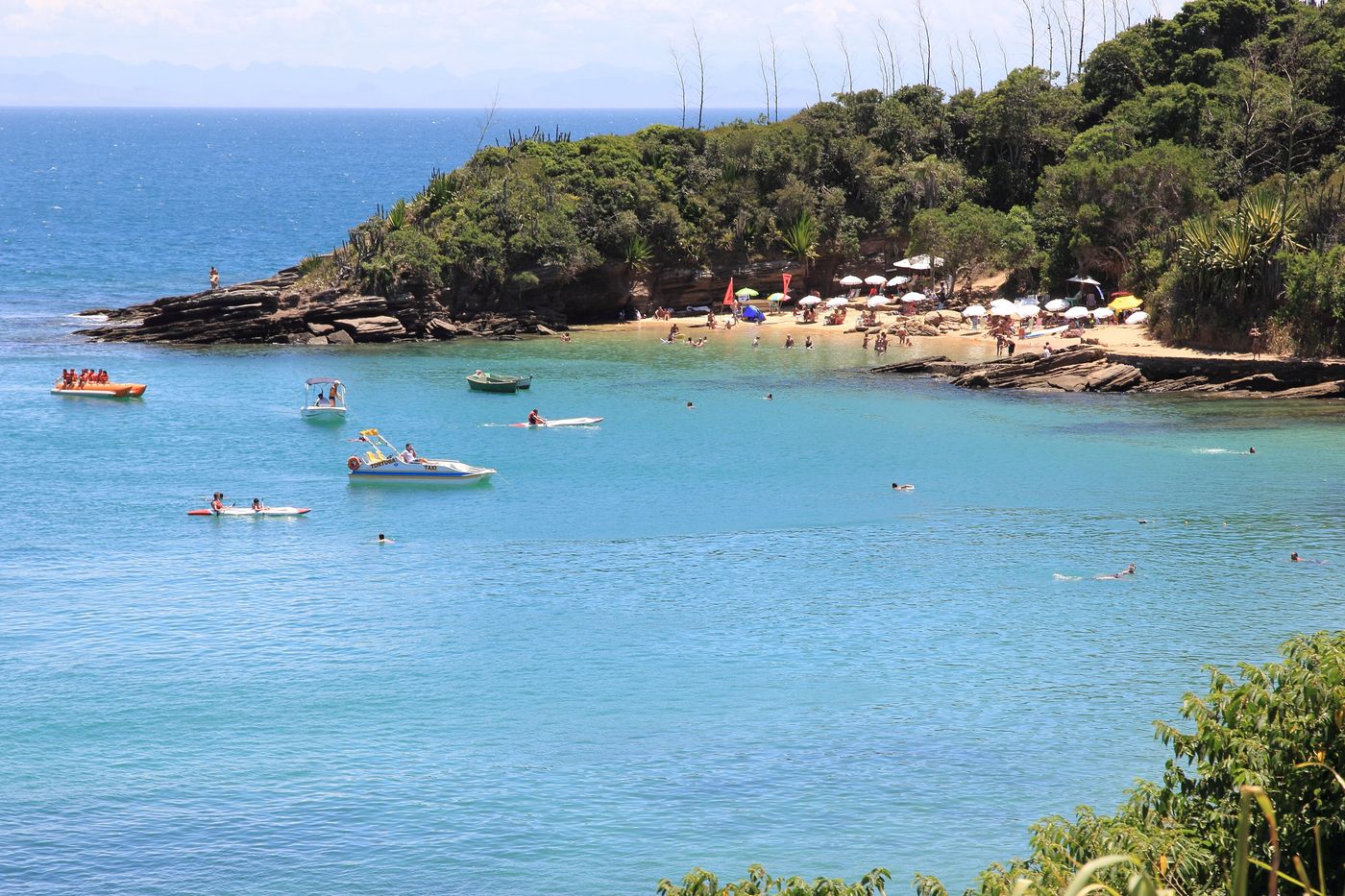
João Fernandes has clear water and restaurants along the sand, and it fills up in high season, so a weekday morning is the best time to go. Its small neighbour, João Fernandinho, is harder to reach, surrounded by trees and usually quieter.
Azeda and Azedinha are two small coves next to each other, both with calm water. You reach Azeda down a wooden staircase, and Azedinha has trees for shade. Both get crowded at weekends, on public holidays and during the summer school break.
Tartaruga has about a kilometre of calm water with kiosks on the sand, and its sunset is one of the most popular in Búzios. Weekends are busy here too, so arrive early for a good spot.
Brava, Manguinhos and Rasa
Praia Brava faces the open sea and, with Geribá, is the surf beach of the peninsula. A rock formation splits it in two, and from its right-hand corner a hard trail leads to Olho de Boi, a small naturist beach tucked between the rocks.
Manguinhos is the beach for wind sports, with windsurfers, kitesurfers and sailing boats on the water, and its sunset is a favourite. Rasa carries on from it as a long, windy strip of sand with relatively calm water, and families like it for that.
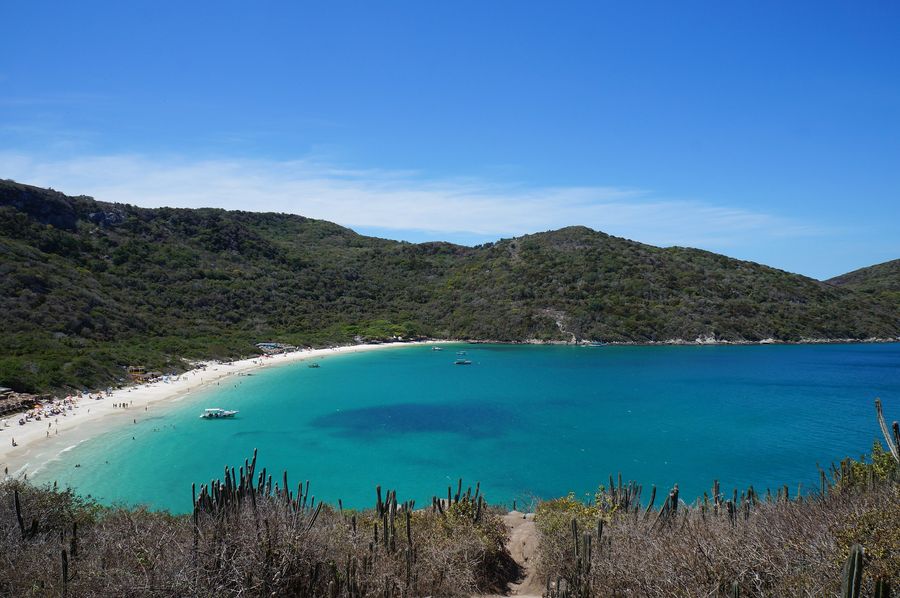
Praia do Forno is one of the sheltered coves, with calm, deep water that suits snorkelling. Arraial do Cabo has a beach with the same name, so tell the driver which one you mean.
Schooner trips
The classic outing is a schooner trip around the peninsula. Boats leave from the pier in the town centre for about two and a half hours on the water, with swimming stops that typically include João Fernandes, the island of Ilha Feia and Tartaruga. Some operators meet their passengers at Praça Santos Dumont in the centre and walk them down to the pier.
Schooners carry more passengers than the catamarans, which run trips of about three hours. A small boarding fee is charged at the pier on top of the ticket, and routes and prices vary by operator, so check before you book.
Water taxis from Ossos and Armação are the other way to hop between the beaches along the bay without the car. Take swimwear and sunscreen, and for a private day on the water closer to home, see Rio's islands by boat.
A night or two in Búzios
Leave the villa early and you can be in Búzios for a late lunch, with the afternoon on Ferradura or João Fernandes. Book a night nearby, walk the Orla Bardot at dusk and have dinner off Rua das Pedras.
Next morning, take the schooner trip or spend a few hours at Azeda, then start back in the early afternoon so you reach the villa before dark. With a second night you can add Geribá, a windsurfing or kitesurfing lesson at Manguinhos and the sunset at Tartaruga.
Arraial do Cabo, known for its clear water, is about 40 km away by road, around an hour by car. The two pair well over a long weekend: stay on the peninsula and make Arraial a day out, or split the nights between them.
When to go
Búzios has a tropical climate and is one of the drier parts of Rio state. Average daytime highs run from 25 to 28°C between November and February and from 23 to 24°C between May and September.
The sea is warmest in late February, when the water at Geribá usually reaches 25 to 28°C, and coolest in early September, at around 21 to 23°C. December is the wettest month, while June, July and August are the driest, with less than 40 mm of rain in each.
Rain in the wetter months usually falls in short showers. Summer and the long holiday weekends bring crowds and traffic on the roads, so for more space on the sand go outside the school holidays. See when to visit Rio for the seasons back in the city.
Questions
How far is Búzios from Rio de Janeiro?
Búzios is about 170 km east of Rio and about 190 km by road from São Conrado. The drive takes around three hours, longer on summer weekends and holidays.
Why is there a statue of Brigitte Bardot in Búzios?
Bardot spent four months in Búzios in 1964, which made the fishing village famous. The Orla Bardot waterfront and her bronze statue by Christina Motta were unveiled in 1999.
Which beaches in Búzios have calm water?
Ferradura, Ferradurinha, João Fernandes, Azeda and Azedinha, and Tartaruga usually have calm water. Geribá and Brava get the waves and draw the surfers.
How long is the schooner trip in Búzios?
Around two and a half hours, with swimming stops that typically include João Fernandes, Ilha Feia and Tartaruga.
Is the water cold in Búzios?
The sea at Geribá usually peaks at 25 to 28°C in late February and drops to around 21 to 23°C in early September.
Pair a night in Búzios with a week at the villa above São Conrado: book direct with Art de Vivre and the concierge will arrange the driver both ways.
Sources
Facts on this page were checked against these sources in October 2026. Opening hours and prices change: confirm before you go.
- Armação dos Búzios (Wikipédia)
- Armação dos Búzios (Wikipedia)
- Por que Brigitte Bardot tem estátua e orla com seu nome em Búzios (IstoÉ, 2025)
- Brigitte Bardot: a francesa que deu visibilidade para Búzios (CNN Brasil, 2025)
- French legend Brigitte Bardot dead at 91: foundation (AFP via EWN, 28 December 2025)
- Brigitte Bardot est décédée à l'âge de 91 ans (Paris Match Belgique, 28 December 2025)
- O que fazer em Búzios: praias e melhores passeios (360meridianos)
- Praias de Búzios (Melhores Destinos)
- Passeio de escuna por Búzios (Civitatis)
- Via Lagos (Wikipédia)
- Geriba water temperature (Surf-Forecast)
- Climatologia de Búzios (Climatempo)
- OSRM route São Conrado to Búzios (OpenStreetMap data)
- OSRM route Búzios to Arraial do Cabo (OpenStreetMap data)