Reserve direct
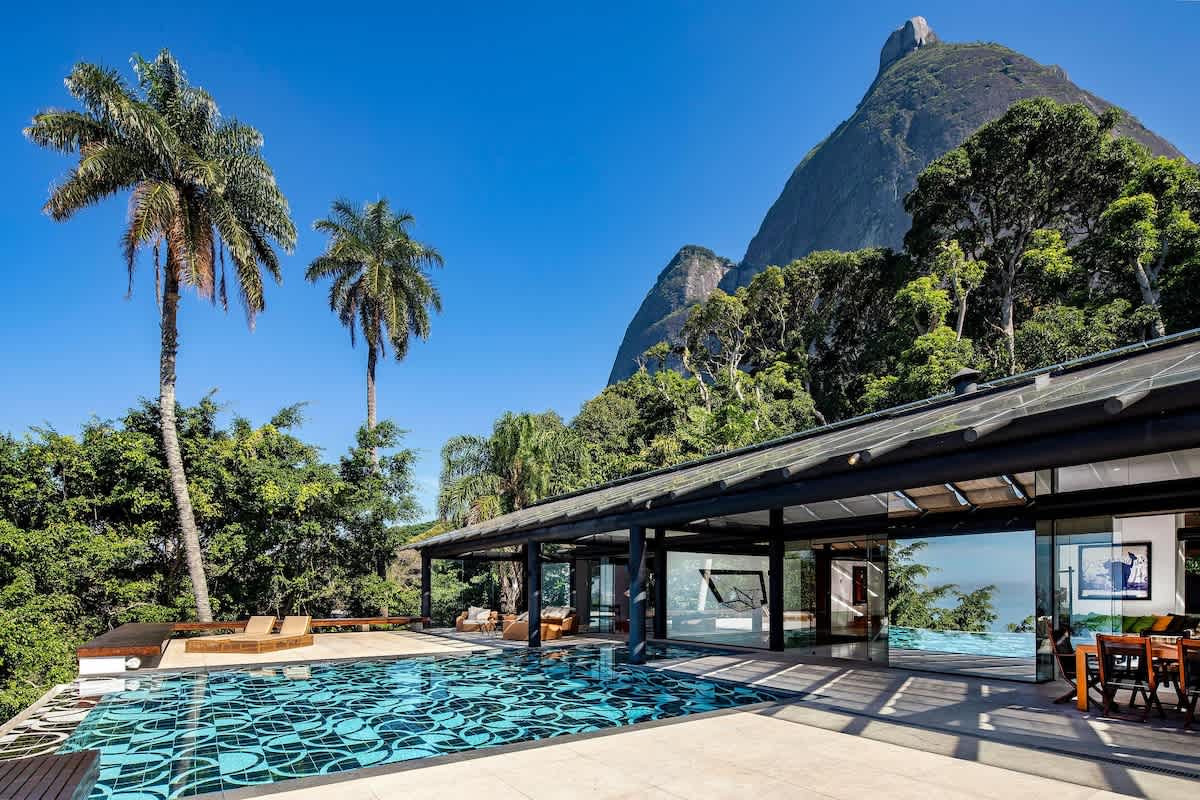
We run a five-suite villa with an infinity pool above São Conrado beach, and its rates and live availability are on the Art de Vivre booking page.
Book directGetting there
The quickest way across starts at Conceição de Jacareí, a small coastal village in Mangaratiba about 130 km west of São Conrado, roughly two hours by car. The route leaves Rio through Barra da Tijuca and then follows the BR-101 west. From the pier, fast boats reach Vila do Abraão, the island's main village, in about 20 to 30 minutes.
The villa's English-speaking driver, arranged through Art de Vivre's concierge, can take you to the pier and meet you there on the way back, which saves leaving a car in a mainland car park for the length of your stay. Private cars cannot go to the island, so you board on foot with your bags.
Boats also leave from Angra dos Reis, about 160 km from São Conrado, and from Mangaratiba. Conventional boats take an hour and a half to two hours and the faster ones about half an hour, while the boat from Mangaratiba has the longest crossing and only one departure a day. Timetables change with the season, so check them before you travel.
In 2026 Angra dos Reis, the municipality Ilha Grande belongs to, introduced a sustainable tourism tax for visitors, paid online through the Viva Angra portal before you cross. Children up to 12 and people over 60 are exempt, and the amount depends on the length of the stay, so check the current rate when you book. The tax is discounted by half in 2026 and by a quarter in 2027.
An island without cars
Ilha Grande covers 193 km² of forested hills and coves, and private cars are not allowed. About 5,000 people live on the island, some 3,000 of them in Vila do Abraão, and everything else moves by boat or on foot.
More than 60 per cent of the island lies inside the Parque Estadual da Ilha Grande, a state park created in 1971 and run by INEA, Rio de Janeiro's state environment institute. Over 90 per cent of the park is covered by Atlantic Forest, and its highest point, the Pico da Pedra d'Água, reaches 1,031 metres. The island's trails are numbered, so T1 is the short circuit around Abraão and T14 the long walk to Dois Rios.
The best-known summit is the Pico do Papagaio, at 982 metres. Its trail is the most demanding on the island, about 5.5 km and around six hours, and a local guide is strongly recommended; check INEA's current rules for the park before you go.
In July 2019 UNESCO listed the island, together with Paraty on the mainland, as a World Heritage site for both culture and nature, the first mixed site in Brazil. You can read about the other half of the listing in our Paraty guide.
Vila do Abraão
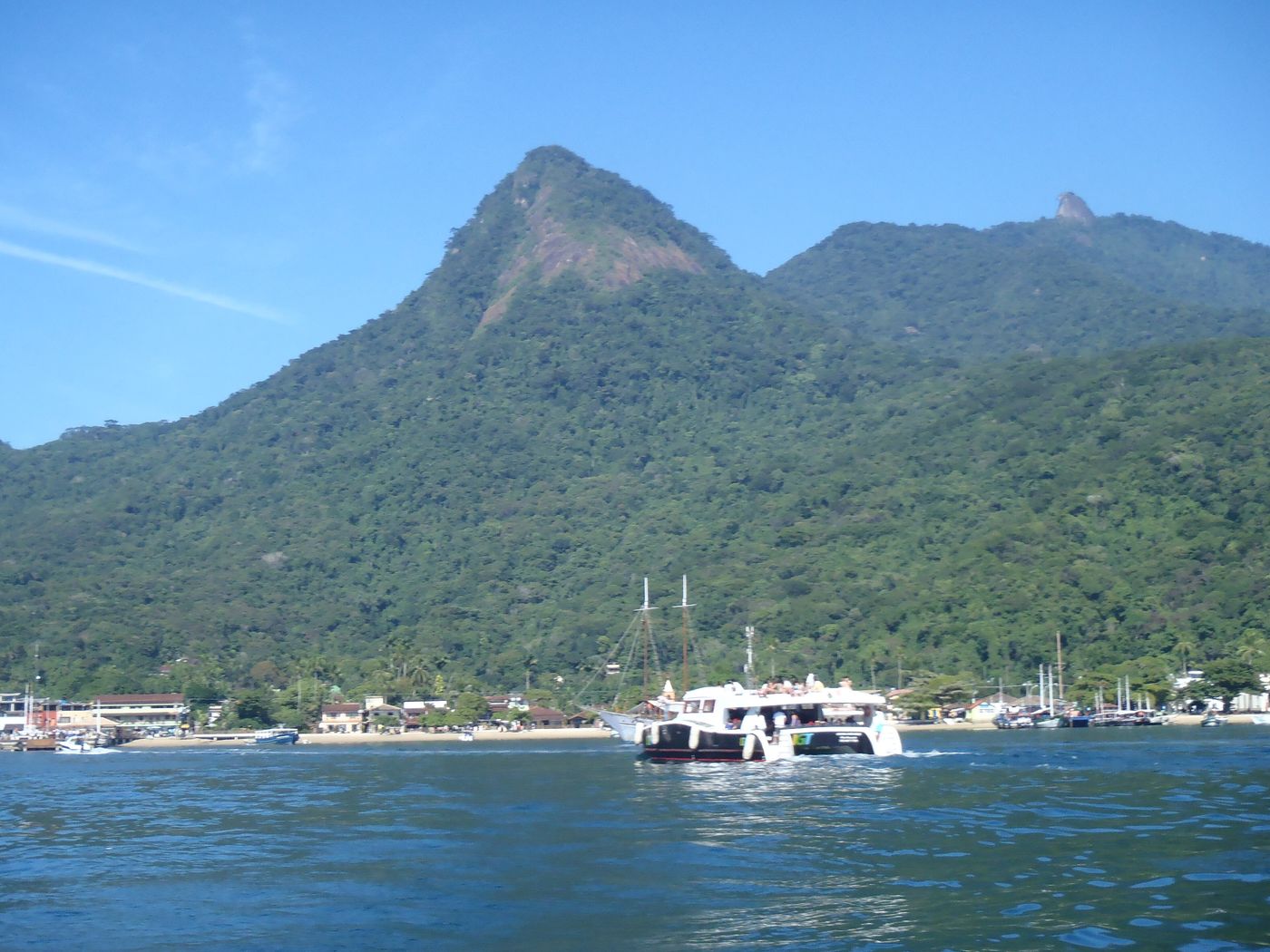
Abraão is where most boats arrive, and it has most of the island's restaurants and the agencies that run the boat trips. It is the natural base for a stay, with the pier, the beach and the trailheads all within walking distance.
The easiest walk from the village is the T1 circuit, about an hour on a low-difficulty trail that children can manage. It passes the ruins of the Lazareto, where European immigrants were received at the end of the 19th century, and the aqueduct that carried water to it, about 125 metres long and 30 metres high. The Poção, a natural pool in the forest on the same trail, is good for a swim.
Dom Pedro II bought the Fazenda do Holandês, where the Lazareto was built, in 1863, and the building later served as a sanatorium for leprosy patients. The forest has taken back most of it, and only a few arches show from the trail.
Lopes Mendes
Lopes Mendes is the beach most visitors come for: nearly 3 km of sand, uninhabited and well preserved, on the ocean side of the island. The water is shallow and clean, the waves draw surfers, and the sea is rougher and cooler than in the sheltered bays, so swim with a little care. The right-hand end is the liveliest, while the left, where a freshwater stream runs into the sea, is often nearly empty.
Boats leave Abraão every day for Praia do Pouso, and from there trail T11 takes you about a kilometre through the forest to Lopes Mendes in 20 to 30 minutes. Keen walkers can hike the whole way from Abraão on trails T10 and T11, about 5.6 km and three hours.
There are no restaurants on the sand, only vendors in summer and at weekends, when surfboards can also be rented, so bring water and snacks. Pouso itself is calm and has a few places to eat, which makes it easy to split the day between the two beaches. Check the time of the last boat back from Pouso before you set off, and allow half an hour for the walk back.
Lagoa Azul and Lagoa Verde
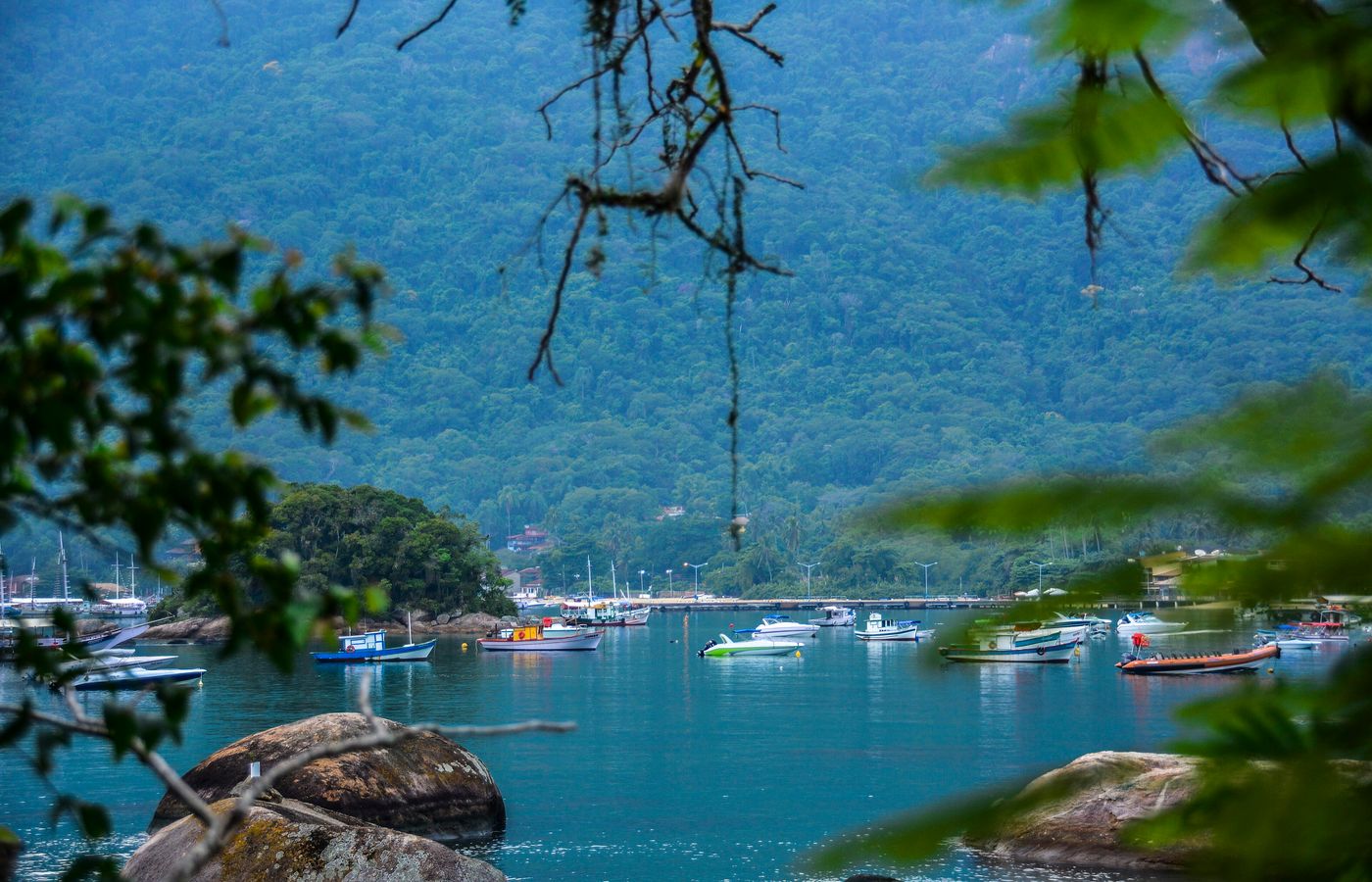
The boat trips from Abraão are the other big day out. Lagoa Azul, off the Freguesia de Santana peninsula on the island's north side, is an area of shallow, clear water near a group of small islands, and you can snorkel there among striped fish. The only way there is by boat.
Lagoa Verde has emerald water and is a favourite snorkelling stop, where tours usually spend 40 to 50 minutes. Day tours of about six hours combine the two with a lunch stop and a beach such as Feiticeira, leaving from the pier in Abraão.
For a group of ten or twelve, ask about a private speedboat. Agencies in Abraão run private trips for groups of up to about 15, which lets you set the pace and linger where the water is clearest. For a skippered day closer to the villa, see Rio's islands by boat.
Dois Rios and the old prison
On the ocean side of the island, Dois Rios is a 1 km beach with a freshwater river at each end and rough surf. A correctional colony opened here in 1903 and later became the Instituto Penal Cândido Mendes, a prison built for about 1,000 inmates from around 1940.
The prison closed in the early 1990s, and in 1994 the state government demolished most of its buildings. The site now houses the Museu do Cárcere, part of the island's eco-museum, and you reach it on trail T14, about 7 km and three hours from Abraão. The route follows an open track and is not technically difficult, only long.
Overnight stays are not allowed at Dois Rios, so start back in good time. Boat tours pass the beach without stopping, as there is no pier and the sea is rough.
Two or three nights
Ilha Grande works best as a stay rather than a day trip, so book a night or two nearby on the island and let the driver collect you from the pier at the end. Pack light, as you will carry your bags from the boat, and bring shoes with a good grip for the forest trails.
On the first day, leave the villa in the morning, cross at midday and walk the T1 circuit to the Poção before dinner in Abraão. On the second, take the boat to Pouso and spend the day at Lopes Mendes. On the third, join a boat trip to Lagoa Azul and Lagoa Verde, or charter a private one, then cross back in the afternoon.
Hikers can swap a beach day for Dois Rios or, with a guide, the Pico do Papagaio. If you enjoy the trails, the concierge can arrange a guide for the Pedra da Gávea and Pedra Bonita hikes back in Rio.
When to go
The coast around Angra dos Reis has a tropical climate with summer rain, about 1,800 mm a year. December is the wettest month and August the driest. Across the year average highs are about 27°C and lows about 20°C; February brings highs of about 30°C, and July days still reach around 24°C, with nights near 17°C.
Summer brings the warmest days and the biggest crowds at weekends and holidays. For long hikes, the drier months from June to August are the easier choice, and on cloudy weekdays even Lopes Mendes can be almost empty. See when to visit Rio for the seasons in the city.
Questions
How do you get to Ilha Grande from Rio?
Drive to Conceição de Jacareí, about two hours from São Conrado, and take a fast boat to Vila do Abraão, about 20 to 30 minutes. Boats also run from Angra dos Reis and Mangaratiba.
Are cars allowed on Ilha Grande?
No. Private cars are not allowed on the island, so you get around on foot or by boat.
How do you get to Lopes Mendes?
Take a boat from Abraão to Praia do Pouso and walk about 1 km on trail T11, around 20 to 30 minutes. The full hike from Abraão is about 5.6 km and three hours.
When was the Ilha Grande prison demolished?
The Instituto Penal Cândido Mendes at Dois Rios closed in the early 1990s, and most of its buildings were demolished in 1994.
Is there a tourist tax for Ilha Grande?
Yes. Angra dos Reis introduced a sustainable tourism tax for visitors in 2026, paid online through the Viva Angra portal before you cross. Children up to 12 and people over 60 are exempt, and the rate depends on the length of your stay.
Spend a few nights on Ilha Grande and come back to the pool above São Conrado: book the villa direct with Art de Vivre, and the concierge will have the driver waiting at the pier.
Sources
Facts on this page were checked against these sources in October 2026. Opening hours and prices change: confirm before you go.
- Ilha Grande (Angra dos Reis) (Wikipédia)
- Ilha Grande State Park (Wikipedia)
- A ilha brasileira onde carros são proibidos e o tempo parece ter parado (Correio Braziliense, 2026)
- Transfer para Ilha Grande desde Conceição de Jacareí (Civitatis)
- Angra dos Reis passa a cobrar taxa de turistas (Itatiaia, 2026)
- Taxa de Turismo de Angra terá primeiras cobranças em janeiro (Correio da Manhã, 2025)
- Praia de Lopes Mendes (Melhores Destinos)
- Ruínas do Lazareto, Aqueduto e Poção (Melhores Destinos)
- Praia de Dois Rios / Presídio (Melhores Destinos)
- Blue Lagoon (Lagoa Azul) (Afar)
- Passeio de barco por Lagoa Azul e Lagoa Verde (Civitatis)
- Melhores passeios de barco em Ilha Grande (Viciada em Viajar, 2024)
- Inea reabre trilha de acesso ao Pico do Papagaio (Super Rádio Tupi, 2020)
- Angra dos Reis (Wikipédia)
- OSRM route São Conrado to Conceição de Jacareí (OpenStreetMap data)