Reserve direct
We run a five-suite villa with an infinity pool above São Conrado beach, and its rates and live availability are on the Art de Vivre booking page.
Book directWhat feijoada is
Feijoada is a stew of black beans cooked with salted, smoked and fresh cuts of pork and beef until the broth turns thick and dark. The full version, the feijoada completa, brings salted dried beef, smoked ribs, bacon, at least two kinds of smoked sausage, and the cuts that give the pot its body: pig's ears, tail and trotters. Each kitchen has its own mix.
On a Rio menu the meats appear in Portuguese: carne-seca or charque for the dried beef, costelinha for the ribs, lombo for pork loin, and paio and linguiça for the sausages. Restaurants often spell out what goes in. Academia da Cachaça in Leblon, for one, lists charque, ribs, loin, paio and a thin linguiça.
The beans change with the region. In Rio and Minas Gerais feijoada is made with black beans, while cooks in Bahia, Sergipe and Pernambuco more often use brown or red beans, and in Bahia and Sergipe add vegetables such as plantain, pumpkin and cabbage. It is often described as Brazil's national dish.
The plate and the sides
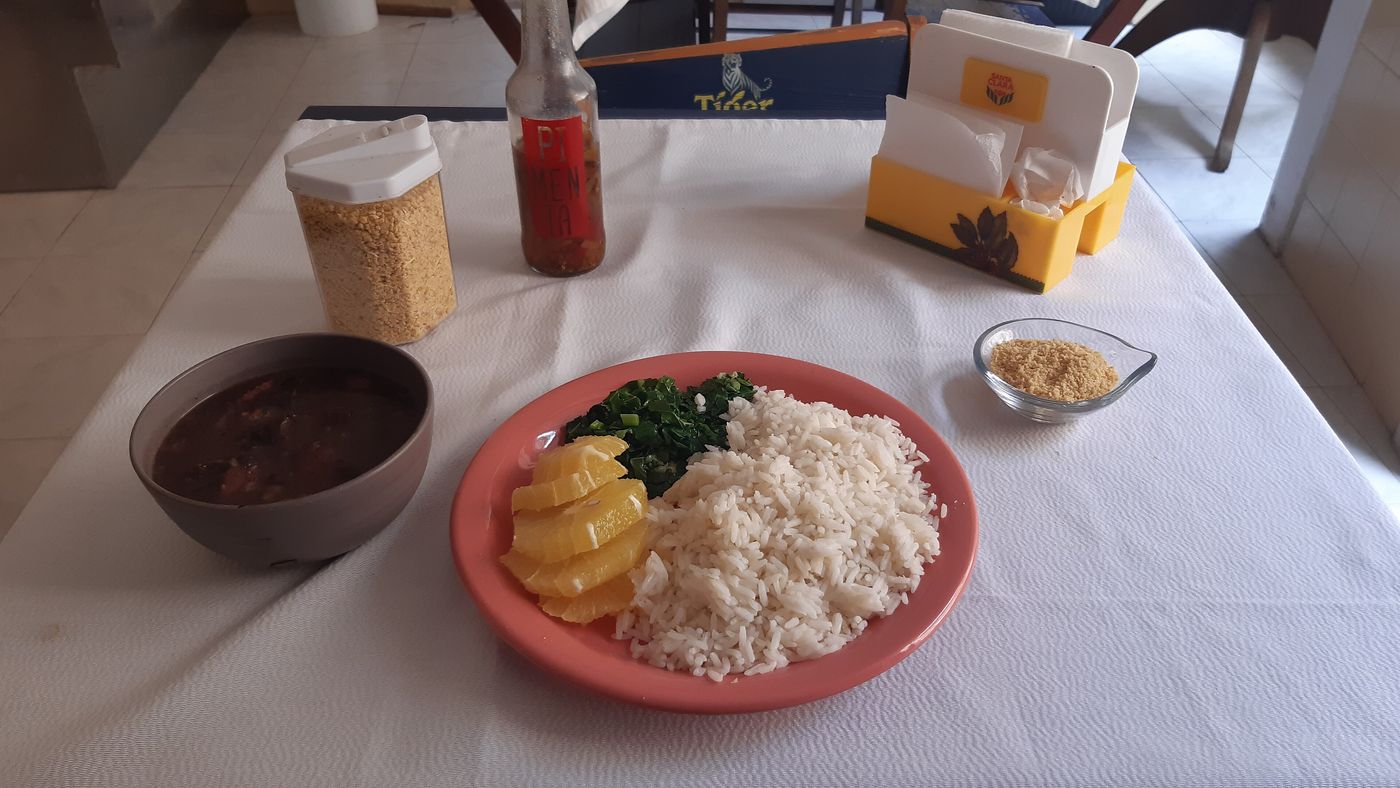
A feijoada comes with the same sides almost everywhere. White rice is the base. Couve is collard greens cut into thin ribbons and sautéed, often in butter. Farofa is manioc flour toasted in fat, often with bacon. Torresmo is crisp fried pork crackling, and slices of fresh orange sit on the side, traditionally to help the digestion.
Build the plate however you like: rice first, beans and meat ladled over, farofa scattered on top, couve and orange alongside. Some places serve it as an all-you-can-eat buffet, others bring it to the table in its pot for two.
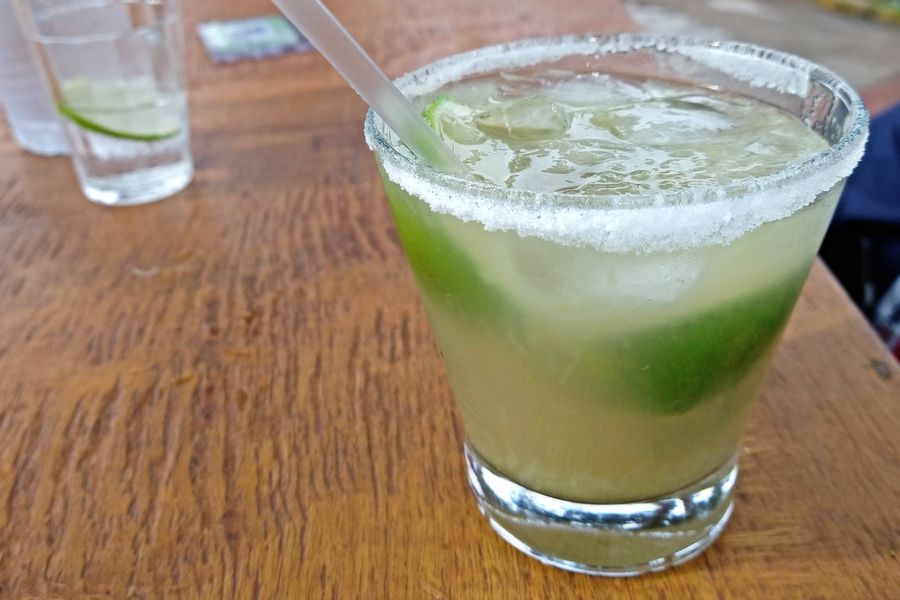
The classic drink alongside is a caipirinha. At Academia da Cachaça, the feijoada for two also comes with a small glass of melzinho, the house mix of aged cachaça, honey and lime. The drink has its own page: Caipirinha and cachaça.
Rio's bars serve feijoada in a smaller form too. The bolinho de feijoada, a fritter made with the ingredients of a feijoada, is credited to chef Kátia Barbosa of the bar Aconchego Carioca. In 2021 the city declared it part of Rio's intangible cultural heritage, and many of the city's botecos now make their own.
Saturday lunch
Feijoada is a weekend meal by tradition, served at Saturday lunch and sometimes at Sunday lunch, when there is time for a long meal. It is a celebration dish, made for a long table. Some Rio restaurants, Rubaiyat at the Jockey Club among them, serve it on Saturdays.
Other days have their own habits. In São Paulo, the working lunch restaurants of the business districts serve it on Wednesdays and Saturdays, and in Rio restaurants have traditionally served it on Fridays. A few places serve it every day, which helps if your Saturday is already taken.
One date belongs to it in Rio: 23 April, the feast of São Jorge and a public holiday in Rio. Through religious syncretism the saint is linked to Ogum, an orixá of the Afro-Brazilian religions, and feijoada is served widely on the day. In 2026 Sobrado da Cidade in the Centro marked São Jorge with its feijoada at lunch.
Where feijoada comes from
The story most often told is that enslaved Africans on colonial plantations invented feijoada from the cuts their owners threw away, such as ears, tails and trotters. Many Brazilians still tell it that way. Historians have long disputed it.
Luís da Câmara Cascudo, the anthropologist who wrote História da Alimentação no Brasil, called the leftovers theory absurd. The Portuguese did not despise those cuts, he noted, and what enslaved people ate day to day was mostly beans with manioc flour. He traced the great bean stew to European stews of beans and meat such as the Spanish puchero and the French cassoulet, and other writers point to the Portuguese cozido.
The written record begins in restaurants. The earliest known mention of “feijoada à brasileira” is an advertisement in a Recife newspaper, the Diário de Pernambuco, in 1827, offering it on Thursdays at an eating house in the city. In Rio, the Jornal do Commercio carried an advert in January 1849 for a café serving it on Tuesdays and Thursdays, and later in the century it was a favourite at G. Lobo, a restaurant on Rua General Câmara in the old centre that closed in 1905.
The food writer Carlos Alberto Dória draws a further line. The everyday feijoada of beans with a little meat was a food of scarcity, while the feijoada completa, with its many cuts and sides, was long reserved for restaurants frequented by the upper classes.
Brazil still made the dish its own. A 2019 study of Rio's nineteenth-century newspapers, published in the journal História & Perspectivas, argues that feijoada was taken up as a Brazilian dish while the young country was building an idea of itself as a nation. Some writers object to the plantation story for another reason too: it suggests a harmony that slavery never had.
Where to eat it in the Zona Sul and Centro
Academia da Cachaça, on Rua Conde de Bernadotte in Leblon, has been open since 1985 and serves its feijoada every day, at any hour. It arrives in the pot with rice, couve, farofa, bacon and orange; in 2025 the version for two cost around R$ 180. Leblon is about 15 minutes from the villa by car, and there is a second branch in Barra da Tijuca, on Avenida Armando Lombardi, for days spent to the west.
Rubaiyat Rio, the steakhouse inside the Jockey Club on Rua Jardim Botânico, serves feijoada on Saturdays, made with pork from the group's own farm. Of its 350 seats, 160 are on a long veranda overlooking the racecourse and Christ the Redeemer, which suits a large group. The Jockey Club is in the Jardim Botânico neighbourhood.
In the Centro, Sobrado da Cidade fills an 1865 townhouse on Rua do Rosário, a few steps from the Centro Cultural Banco do Brasil, and serves its Feijoada Tradicional every day at lunch, with a vegetarian feijoada at the same price. In 2026 it cost around R$ 79 for one and R$ 152 for two; prices change, so check the menu. Weekends bring live music, with an artistic cover of about R$ 15 a head in 2026. It fits well into a morning in the historic centre.
For a group of ten, have the concierge book Saturday lunch a few days ahead. Other nights out are covered in restaurants and dining near São Conrado.
A samba-school feijoada
Rio's samba schools hold feijoadas at their quadras, the big halls where they rehearse, with a band on stage and the food served on the spot. Portela, the samba school based in Madureira in the North Zone, holds one; in February 2025 it ran at the school's quadra on Rua Clara Nunes.
The event also travels. On 19 September 2026 the Feijoada da Portela was held for the first time at the Renascença Clube in Andaraí, with the Velha Guarda, the school's old-guard musicians, on stage. Dates and venues change through the year, so check Portela's own channels before planning a Saturday around one.
Other schools hold them too. In February 2025, in the run-up to Carnival, Beija-Flor and Mangueira also held feijoadas at their quadras. Madureira is well across the city from São Conrado, so go with the driver, who can drop the group at the door and collect it later. The Carnival guide covers the season itself.
Feijoada at the villa
A feijoada also suits a day at the house. The villa's private chef, booked through Art de Vivre's concierge, can cook one for the group. Ask ahead: the salted meats soak for at least twelve hours to draw out the salt, and the beans soak overnight.
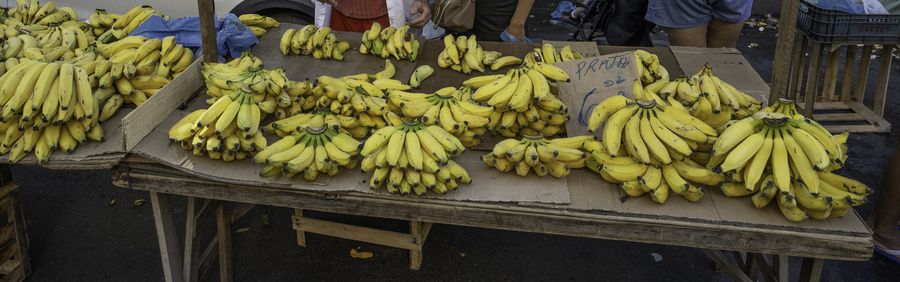
The chef shops the morning markets for the fresh side of the meal, such as oranges, couve and limes for the caipirinhas. Lunch is served at the table for twelve, with the pool there for the afternoon and Pedra da Gávea behind the house.
Saturday is the natural day for it, after a morning on the beach below. Mention it when you book and the concierge will fit it into the week. Food markets near São Conrado covers the markets around the house.
Questions
What day is feijoada served in Rio?
Saturday lunch is the tradition, and some restaurants serve it on Saturdays. Some places serve it every day, including Academia da Cachaça in Leblon and Sobrado da Cidade in the Centro.
Was feijoada invented by slaves?
That is the popular story, but historians such as Luís da Câmara Cascudo rejected it: the Portuguese prized those pork cuts, and enslaved people ate mostly beans with manioc flour. The earliest written mentions, from 1827 onwards, are restaurant advertisements.
What is served with feijoada?
White rice, couve (sautéed collard greens), farofa (toasted manioc flour), orange slices and torresmo (pork crackling), usually with a caipirinha.
Is feijoada eaten at lunch or dinner?
Mostly at lunch, often a long one on a Saturday. Sobrado da Cidade in the Centro, for example, serves it from late morning to late afternoon.
Can the villa's chef make a feijoada?
Yes. The private chef arranged through Art de Vivre's concierge can cook one for the group; ask ahead, because the salted meats soak overnight.
Stay at the villa above São Conrado, book direct with Art de Vivre, and ask the concierge for a Saturday feijoada cooked by the private chef.
Sources
Facts on this page were checked against these sources in October 2026. Opening hours and prices change: confirm before you go.
- Feijoada (Brazilian dish), Wikipedia
- Feijoada and Hoppin' John: Dishing the African Diaspora in Brazil and the United States, Southern Cultures (2019)
- Projeto de Lei nº 324/2021, Assembleia Legislativa de São Paulo (cites Câmara Cascudo)
- Independente do passaporte, a feijoada é nossa, O Hoje (2018)
- Tipicamente nacional? A feijoada no Rio de Janeiro oitocentista, História & Perspectivas (UFU)
- Academia da Cachaça, official site
- Academia da Cachaça comemora 40 anos, Sopa Cultural (Feb 2025)
- Rubaiyat Rio, Grupo Rubaiyat
- Sobrado da Cidade transforma almoço no Centro em um mergulho na história do Rio, Diário do Rio (Sep 2026)
- Feijoada em todos os estilos, Correio da Manhã (Apr 2026)
- Feijoada da Portela estreia no Renascença Clube, Diário do Rio (Sep 2026)
- Feijoadas nas escolas de samba do Rio, TudoGostoso (Jan 2025)
- Devotos de São Jorge e Ogum celebram feriado, Alma Preta (2024)
- Bolinho de feijoada é declarado patrimônio cultural imaterial do Rio, Metrópoles (2021)
- Feijoada perfeita: 10 dicas, TudoGostoso
- Onde comer feijoada no Rio de Janeiro (Diário do Rio, April 2025)