Where the arithmetic flips
A hotel is an excellent product for one or two people. Someone else makes the bed, breakfast appears, the front desk fixes problems, and you are paying for exactly one room. None of that changes when you add guests — which is precisely the issue, because everything scales linearly. Five couples in a good Rio hotel is five rooms, five room rates, five breakfasts, and five sets of keys, and nothing about the experience gets better as the group grows.
A house scales the other way. The rate is for the house, so the tenth guest costs very little more than the eighth, and the shared parts — the terrace, the pool, the kitchen, the long table — get better with more people in them rather than worse. Somewhere around six guests those two curves cross. By ten they have separated widely enough that the house is usually the cheaper option outright, before you count what it adds.
The number that surprises people is meals. Ten people eating three meals a day out for a week in the South Zone is twenty-one restaurant sittings for a party of ten, which in Rio means booking ahead, splitting tables, and moving the whole group twice a day. With a cook in the house, breakfast and dinner stop being events you organise, and the restaurant budget goes toward the four or five dinners you actually wanted to go out for.
What the house adds that a hotel cannot
The first thing is that the group is in one place. In a hotel a group of ten fragments — people are on different floors, they meet in a lobby, and the day begins with texting about where to have breakfast. In a house everyone wakes into the same kitchen, and the natural default is that you are together, with the option to disappear to a suite rather than the other way round.
The second is that evenings happen at home. This is the biggest single difference and the hardest to convey in advance. When dinner is on the terrace, the day doesn't end at a restaurant door at eleven — the pool stays lit, the children go to bed upstairs while the adults stay at the table, and nobody is driving. In Rio, where getting a party of ten back up a hill at midnight is a genuine logistical operation, this matters more than it would in a walkable city.
The third is privacy. No lobby, no other guests, no restaurant tables next to yours, no one photographing the group by the pool. For people who want a holiday nobody is watching, a private house behind a gate is a different category of thing from a suite, and that is a large part of why houses on this coast exist at all.
The fourth is that space is yours. A pool you don't share, a table you don't book, a kitchen you can raid at midnight, and a terrace where a birthday can run late without a noise complaint from room 604.
When the hotel genuinely wins
Two or three nights. A house makes sense over a week; for a short stop the arrival, the settling in and the shopping run eat too much of the trip, and a hotel's frictionlessness is worth more.
A group of two or four. Below about six guests you are paying house money for rooms you won't use.
If walking out into the street is the point. A hotel in Ipanema or Copacabana puts you inside the city's life in a way a hillside house cannot. If the plan is bars, late nights and no car, the hotel is the right answer and São Conrado is the wrong neighbourhood — the comparison of neighbourhoods sets that out plainly.
If you want hotel infrastructure specifically: a gym you'll use daily, a spa, a concierge desk at three in the morning, room service, a business centre, or the ability to add a room at short notice. A house arranges most of these through people rather than facilities, which is usually better and occasionally slower.
And if nobody in the group wants any responsibility at all. A house with full service comes close, but somebody still decides what the cook makes on Thursday.
The logistics you should think about honestly
Transport is the main one. A house on a hillside means using a car or a driver for dinner and for the beaches to the east. Budget for that rather than discovering it. A dedicated driver for the stay solves it completely and is the normal arrangement for a house of this size; ride apps work well in Rio too, but ordering three cars for ten people every evening gets old.
Food supply is the second. The first day involves a proper shop, which a cook or a house manager can do before you arrive if you send preferences in advance. Ask for it — arriving to a stocked kitchen changes the first evening entirely.
Sleeping arrangements are the third and the one groups sort out too late. Ten people in five suites means couples, or people sharing, and it is worth allocating rooms before anyone lands, especially where suites differ in size and view. Ask for a floor plan and the bed configuration in each room, not just a total.
Finally, noise and neighbours. Inside a residential estate you have a lot of freedom and one obligation: it is a neighbourhood of family houses, not a party venue, and a house of this kind is let on that understanding.
How this house is set up for a group
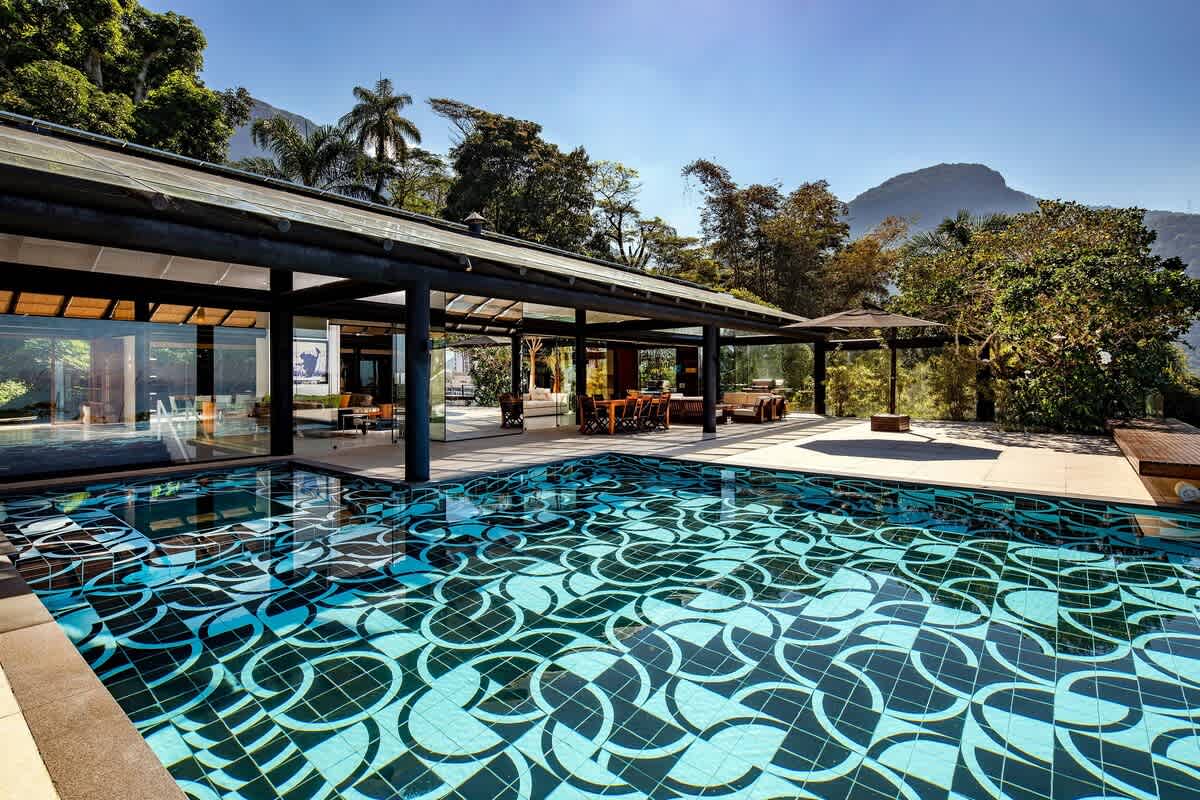
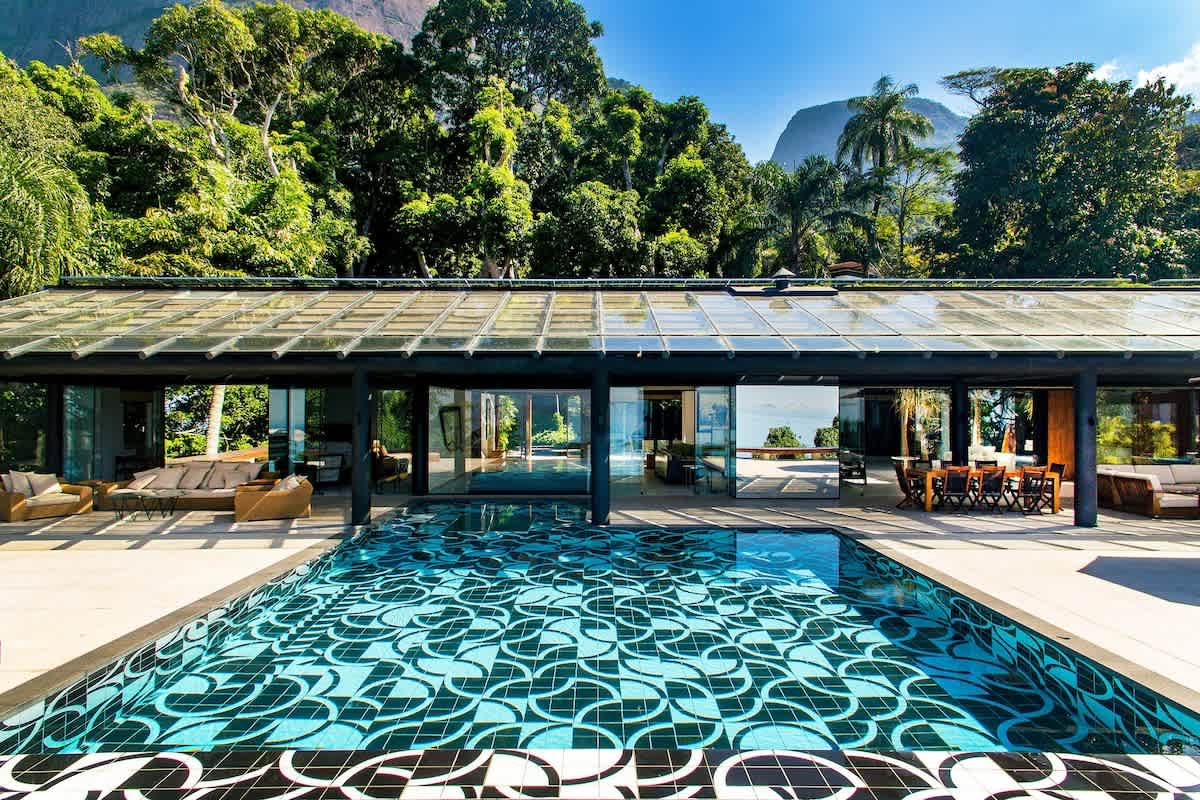
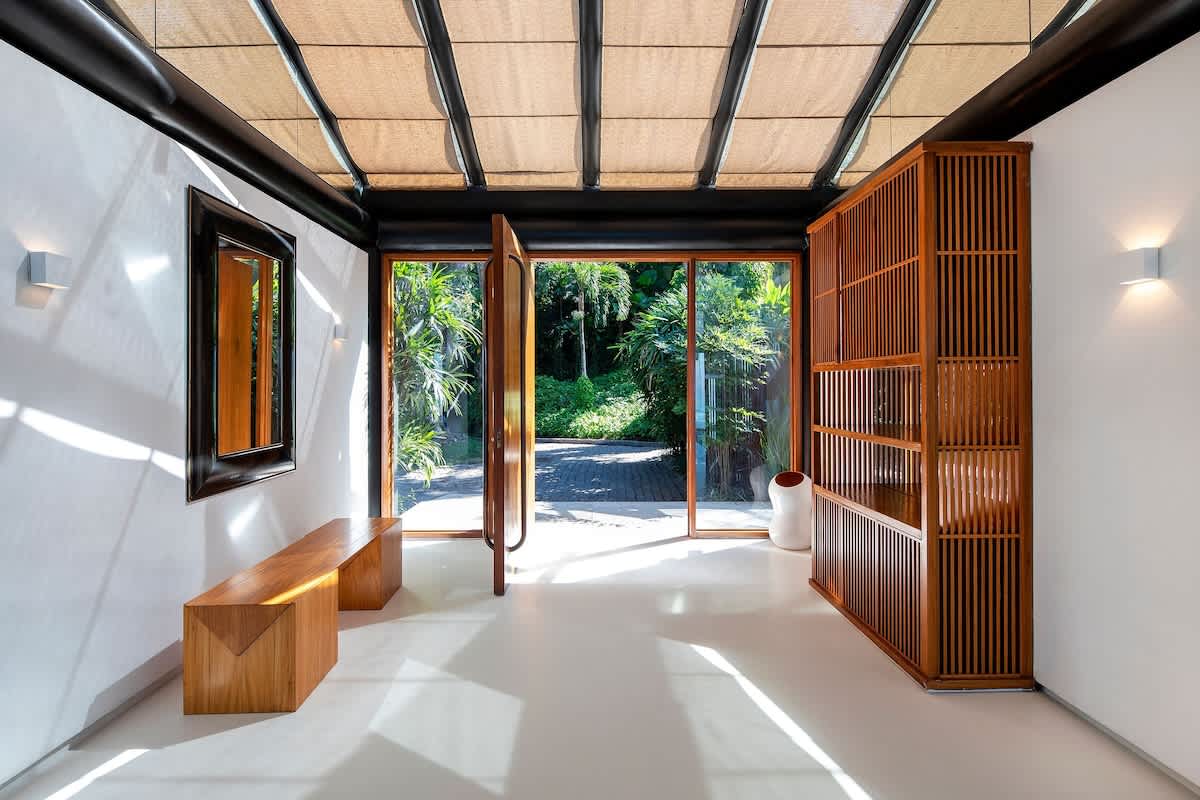
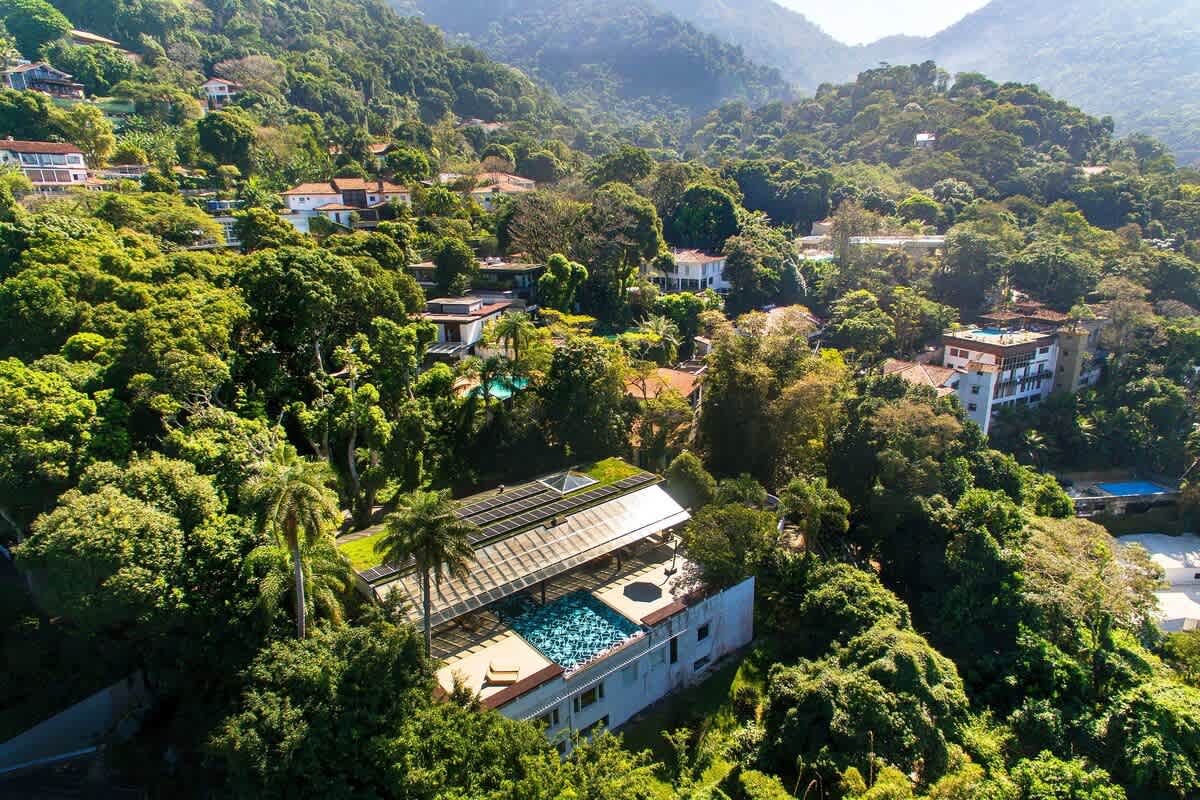
Five suites and six bathrooms, comfortable for ten and up to twelve, in nine hundred square metres on the São Conrado hillside inside a private gated estate. The main living space is a glass pavilion that opens onto the terrace, so the inside and the outside are effectively one room during the day. The dining table seats the whole group at once, which sounds minor until you have tried to feed ten people at two tables.
The pool is private, mosaic-tiled, with an infinity edge on the sea side, the beach below and Pedra da Gávea behind the house. Chef, daily housekeeping, a driver and airport pickup are arranged through Art de Vivre before you arrive, and the concierge handles the things groups actually ask for — a boat day, a tandem flight from the Pedra Bonita ramp, a table in Leblon for the one night you do want to go out, a guided climb up Pedra da Gávea.
If the group includes children, Rio with children covers the practical side. If you are marking an occasion, hosting a celebration at the villa covers what the house can and can't do.
What to ask before you commit either way
For the hotel: can you get adjoining rooms, on the same floor, confirmed rather than requested? What does breakfast for ten cost per day? Is there anywhere the group can sit together in the evening that isn't a public bar?
For the house: what exactly is included in staff terms and hours; is the pool private and is it heated; is the entrance staffed twenty-four hours; how many cars fit inside the gate; and what is the written cancellation policy. Then ask for a video walk-through from the gate to the pool. The full checklist is in how to book a luxury villa in Rio.
Do both sets of sums with meals included. That is the comparison people skip, and it is usually the one that decides it.
Tell us the group and the dates and we'll come back with the bed configuration, what the staff covers, and what a week here usually looks like.