What you are watching from the terrace
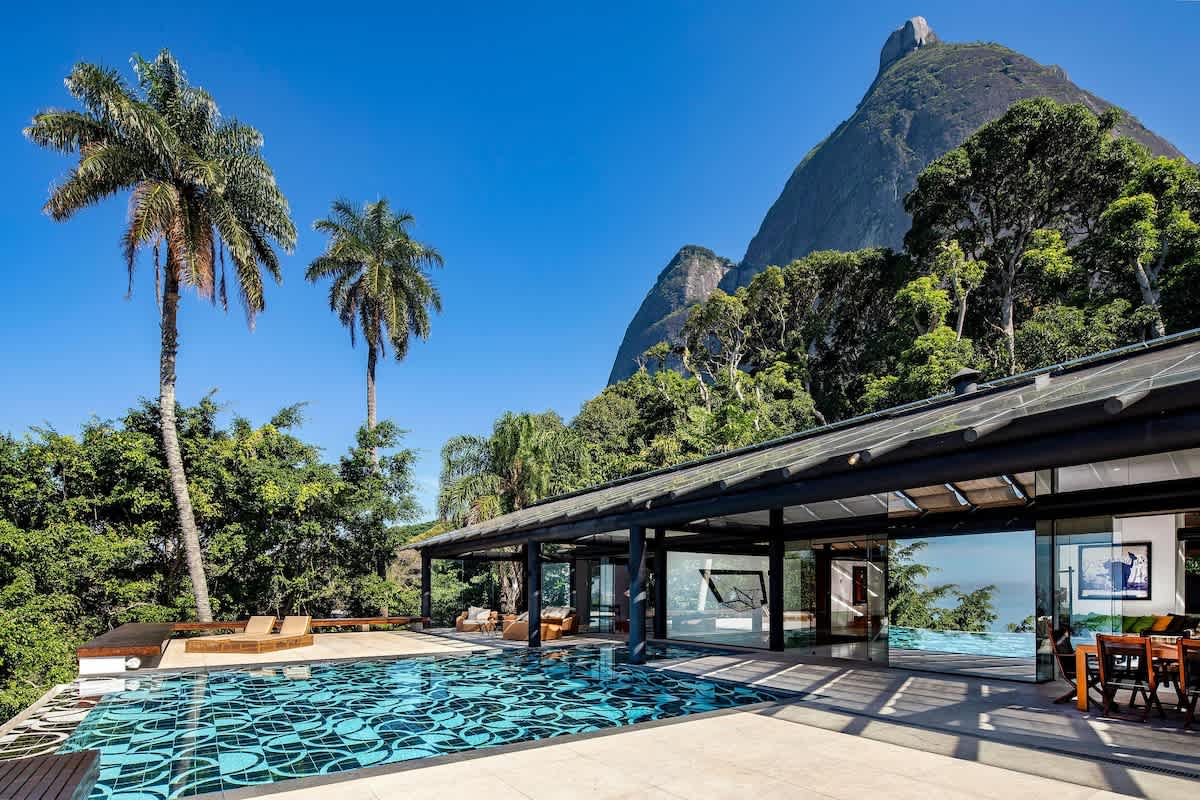
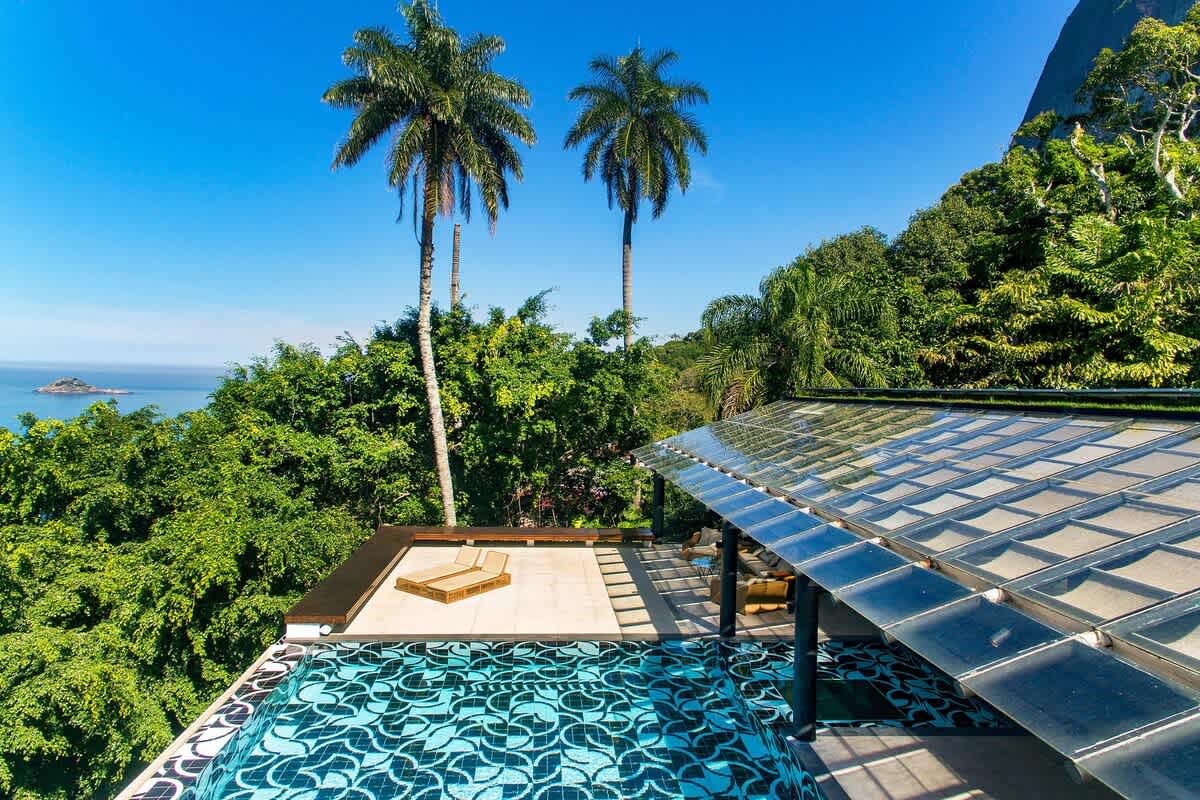
On most afternoons, coloured wings appear over the ridge behind the house, turn out over the hillside, and drift down in wide slow circles toward the beach. They come from the Pedra Bonita ramp, high on the ridge that runs between Pedra da Gávea and the Tijuca forest, and they land on the sand at the western end of São Conrado Beach. From the pool terrace you see the whole descent, which takes roughly ten to fifteen minutes.
This is not an occasional spectacle put on for visitors. São Conrado is one of the world's best-known free-flight sites, the ramp is the oldest in Brazil, and on a good day there is a queue of pilots waiting to launch. The traffic is part of the neighbourhood's daily rhythm in the way commuter trains are part of other places.
It also explains something about the neighbourhood. The gliders need clear air over the hillside and a landing field at the bottom, which is one of the reasons this stretch of coast stayed low-rise and green while the beaches to the east filled with towers.
The ramp itself
The Rampa de Voo Livre da Pedra Bonita sits at about 520 metres above sea level, inside Parque Nacional da Tijuca, and it was Brazil's first free-flight ramp. There are two launch structures side by side — one for hang-gliders, one for paragliders — plus a snack bar and toilets for pilots and spectators. The São Conrado free-flight club, CSCVL, operates from the site.
You reach it from São Conrado by driving up Estrada das Canoas, a narrow, steep, winding road that climbs the ridge. It is roughly seven kilometres from the landing beach, and about ten to fifteen minutes from the house depending on traffic on the hill. Tandem operators normally collect you and bring you back.
The ramp is worth visiting even if nobody in the group intends to fly. It is a free public viewpoint inside the national park, with a straight view down over São Conrado, the beach, Joá and — on a clear day — the long line of Barra da Tijuca beyond. Watching pilots rig and launch from a few metres away is more interesting than most organised excursions, and it costs nothing.
The short walk to Pedra Bonita's summit lookout starts nearby and is a gentle option compared with the full Pedra da Gávea climb.
What a tandem flight is actually like
You fly with a licensed pilot in a two-person wing, so no experience or training is required. The pilot handles everything; your job is to run a few steps off the ramp when told and then to sit still and look.
The sequence is straightforward. You are driven up to the ramp, fitted into a harness and helmet, and given a two-minute briefing that is mostly about the launch run. On the pilot's call you run three or four steps down the ramp, the wing takes the weight almost immediately, and the ground drops away. Then it is quiet. Hang-gliders are laid out prone and feel fast and clean; paragliders sit upright in a seat and feel slower and more sociable.
The flight is generally ten to fifteen minutes from launch to sand, longer if the air is working and the pilot climbs in the thermals. You pass over Atlantic forest and the hillside estates, with Pedra da Gávea over one shoulder and the whole coast toward Ipanema and Leblon over the other. The landing is on the beach, on foot or on the harness depending on conditions, and it is gentler than it looks.
Practical notes: closed shoes, no loose sunglasses or hats, and nothing in your hands. Pilots normally film the flight on a boom camera and sell the footage; agree that before you launch. There is a weight range, so declare weights when booking. Most operators will not fly small children, and the age minimum varies — ask when arranging.
This is an aviation activity with real risk, however routine it looks. Fly with a licensed operator, and expect a professional to cancel on a bad day. A pilot who is willing to fly in unsuitable conditions is not the one you want.
Season, weather and when flights get cancelled
Free flight depends on wind direction and thermals, so it is a morning-and-early-afternoon activity and it is weather-dependent in a way that boat trips are not. Local operators consider September to December the best stretch of the year, when conditions are most reliable. Flights run year-round when the air cooperates.
Rio's summer, from December to March, brings heat, strong thermals and afternoon thunderstorms — flyable, often excellent early, and prone to cancellation later in the day. The cooler months from June to August are clearer and calmer with more stable air and fewer storms, but with a greater chance of a day when the wind is simply wrong.
The practical consequence for a stay: do not book a flight for your last morning. Plan it early in the week so there is room to move it, and treat the first suitable day as the day to go. Groups that leave it to the final afternoon frequently miss it altogether, which is a shame given the ramp is fifteen minutes from the house.
When to visit Rio covers the seasons in general terms; for flying specifically, September to December is the answer.
Praia do Pepino and the landing field
Gliders land at the western end of São Conrado Beach, on the stretch known as Praia do Pepino and the grassed landing area beside it. If you are watching rather than flying, this is the place to stand — wings arrive every few minutes on a busy afternoon, and the last thirty seconds of a flight are the interesting part.
There is a memorial on that beach worth knowing about. Pedro Paulo Guise Carneiro Lopes — Pepê — was a Rio athlete who won the hang-gliding world championship in 1981, at twenty-four, at Beppu in Japan. Ten years later, in April 1991, he died aged thirty-three while competing at a free-flight tournament in Wakayama, also in Japan, having finished that championship as runner-up. A plaque was installed at Praia do Pepino near the landing strip in 2011, twenty years after his death. Pilots landing here still know exactly who he was.
Watching from the sand costs nothing, works even when the weather stops flights, and is one of the better ways to spend an hour with children who are too young to fly. More on the beach itself.
Arranging it from the house
The concierge books tandem flights with licensed pilots and arranges the transfer up to the ramp and back. Give notice and give weights, and where possible give two or three possible mornings rather than one, so the flight can be moved to the best air rather than cancelled.
For groups, flying happens in sequence rather than all at once, so a party of six is a morning rather than an hour. The usual shape is that some of the group flies while the rest watches from the beach with coffee, then everyone is back at the house by lunch.
If nobody wants to fly, ask to be driven up to the ramp anyway, ideally late morning when the launch queue is busy. It is a fifteen-minute drive for a genuinely unusual hour.
Tell us who wants to fly and give us a few possible mornings — we'll book licensed pilots and the transfer up to the ramp, and move it to the best day rather than the fixed one.