The question behind the question
"Where should we stay in Rio" is really two questions wearing one coat. The first is how much you want to walk out of the door into a busy street — bars, queues, vendors, people. The second is how much of your day you intend to spend at the place you're sleeping. A couple who will be out from nine in the morning until midnight wants Ipanema. Ten people with a pool and a cook want the hillside, and would be irritated by Ipanema's noise and parking.
Rio's South Zone runs west along the coast in a line: Copacabana, then Ipanema, then Leblon, then a tunnel and a cliff road to São Conrado, then Joá, then the long flat sprawl of Barra da Tijuca. Everything is roughly on one axis, so the practical difference between neighbourhoods is mostly density and elevation. As you go west the buildings thin out, the hills get steeper, and the houses start to appear.
Below is each one on its own terms, including the parts that don't flatter it.
Ipanema and Leblon
These are the two most desirable addresses in Rio and for good reason. You can live without a car: the beach is at the end of the street, the restaurants are walkable, the produce markets are good, and the whole stretch from Arpoador to the Leblon end is one continuous promenade. Leblon is the quieter and more residential of the two, Ipanema the more social, and both are safe by Rio standards in the sense that they are busy and well-lit late.
The costs are density and form. Both neighbourhoods are almost entirely apartment buildings — you will be in a flat, not a house, and if there is a pool it is on the roof and shared with the building. Traffic and parking are genuinely difficult, especially in summer and at weekends. Beachfront apartments get street noise from the avenue, and the beach itself is crowded from December to March.
Choose these if the point of the trip is the city and the street, if you're two or four rather than ten, and if you'd rather be able to walk home from dinner than have a terrace to eat on.
Copacabana
Copacabana is the most famous beach in the world and the densest neighbourhood on this list. It has the best hotel stock in the city, the widest range of prices, an actual metro line, and a genuine round-the-clock street life. If you want to be in the middle of Rio's noise and history, this is it, and the Réveillon fireworks happen on this sand.
It is also the most touristed, the most worn at the edges, and the least private. The beachfront is a wall of buildings, the pavements are busy at every hour, and the further you get from the water the more ordinary the streets become. A family of ten in Copacabana is in three or four hotel rooms, eating out three times a day.
Choose it for a short first visit, for a New Year's Eve where you want to be inside the crowd rather than watching it, or for hotel service at a price point the west side doesn't offer.
São Conrado
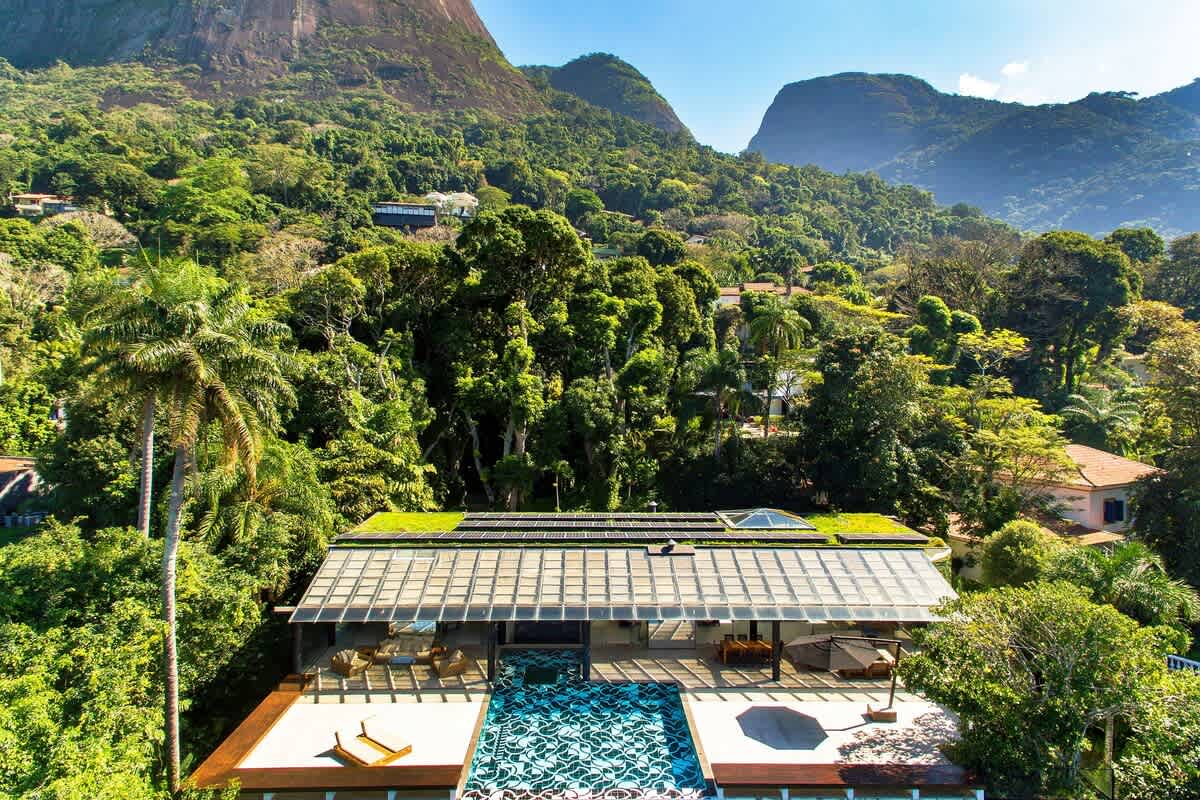
São Conrado is where Rio stops being vertical. It sits between the sea and Pedra da Gávea, hemmed in by the Tijuca forest, and the land climbs fast behind the beach into hillsides of gated estates and private houses. It is residential first, low-rise, and green in a way none of the neighbourhoods east of it are. It has the Gávea Golf & Country Club, the Niemeyer-designed Hotel Nacional on Avenida Niemeyer, and hang-gliders landing on the sand most afternoons.
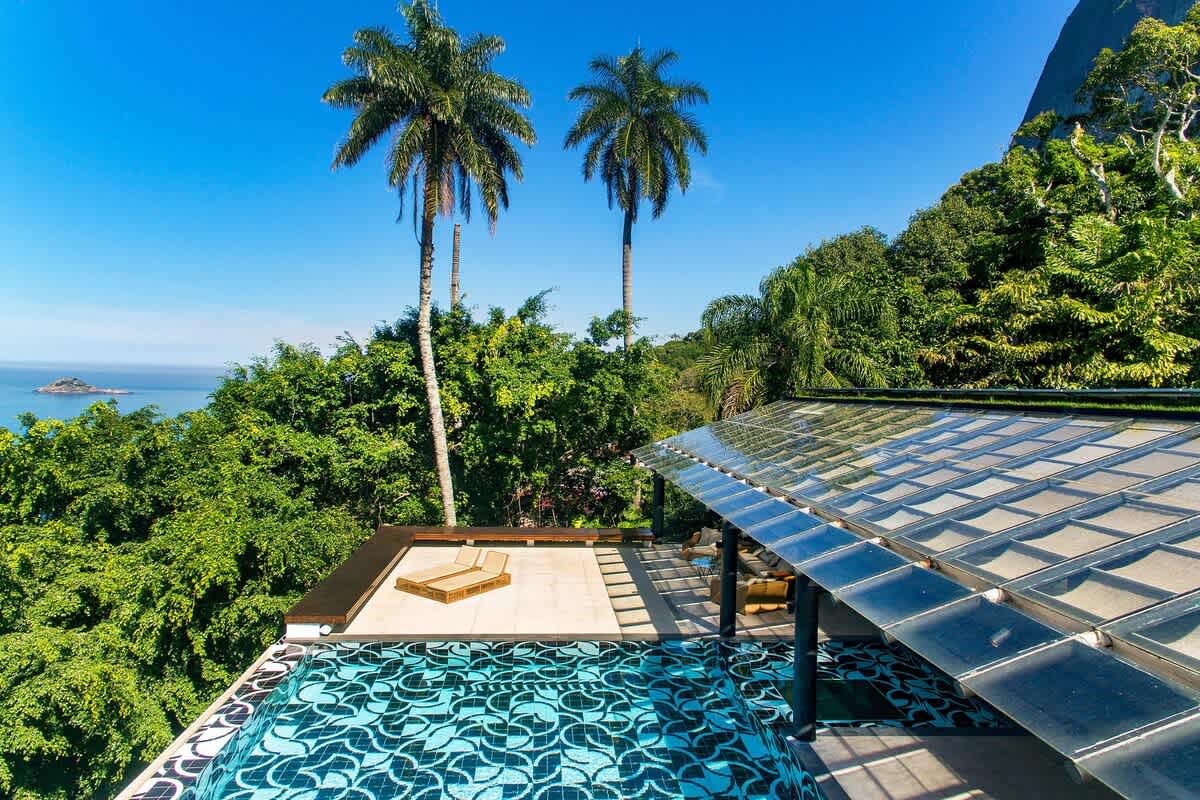
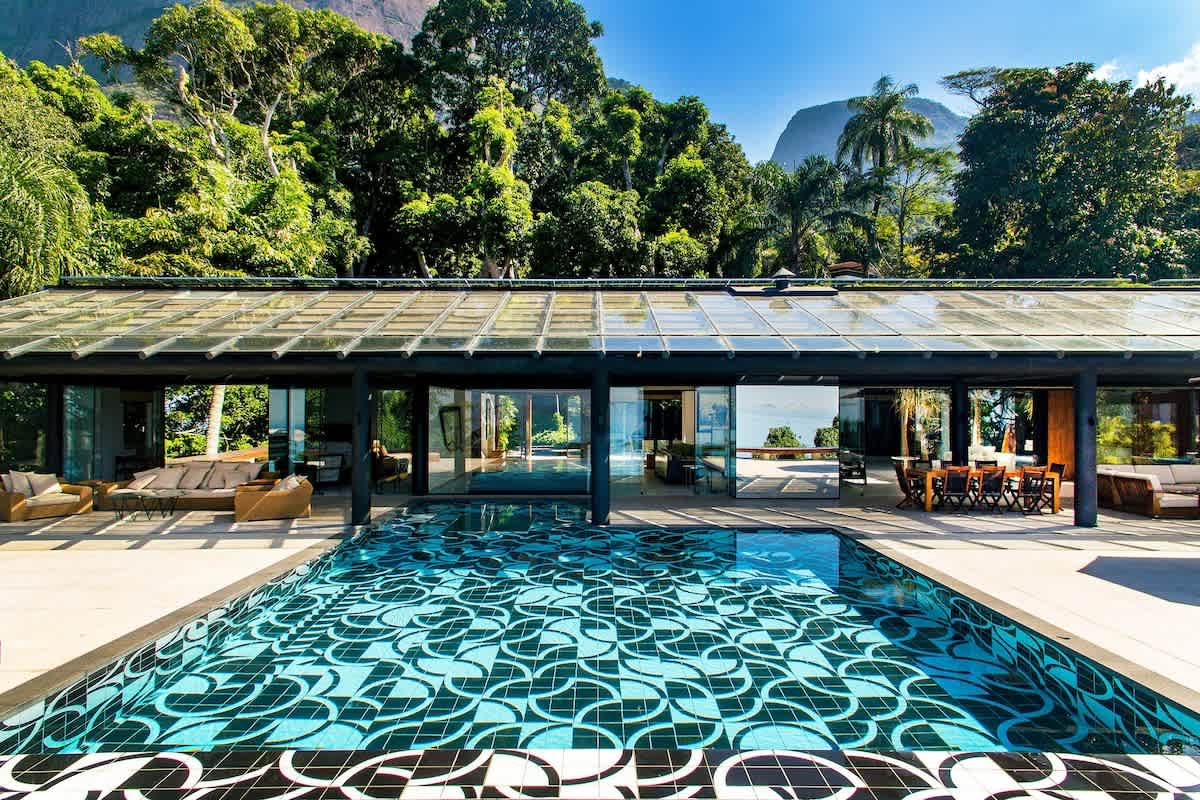
What it buys you is space and quiet with the beach still below you and Leblon about fifteen minutes down the coast road. This is the part of Rio where a group can rent a whole house with a private pool and a real view, which is essentially not possible in Ipanema. The forest behind means cooler air on the slopes and birds and small monkeys near the houses.
What it costs you is walkability. São Conrado is not a neighbourhood you stroll for dinner — the good restaurants are mostly up the hill in Gávea, at the hotels on Avenida Niemeyer, or fifteen minutes east in Leblon, so you use a driver or a car in the evening. The commercial strip is thin; the Fashion Mall is next door and has a cinema and services but is a shadow of its 1980s self, and serious shopping means Leblon or Barra. The beach is a real Rio beach with kiosks rather than a resort strip, and the surf end picks up more swell than the calm end.
Choose São Conrado if you are a group in a house, if the view and the pool are the point, if you want children able to move around freely inside a gate, and if you are comfortable driving fifteen minutes to eat. The full neighbourhood guide goes deeper, and the history explains how it came to look like this.
Joá
Joá is the smallest neighbourhood in Rio: a clifftop of private houses immediately west of São Conrado, reached by the coastal viaduct and tunnels. There is almost nothing commercial there at all. Its beach, Praia da Joatinga, is under three hundred metres long, tucked in the rocks, reached through a private residential street and down a stairway, and it disappears at high tide.
It is the most private address on this coast and the least convenient. If total seclusion above the water is the brief, Joá answers it; you accept that everything except the view requires a car. Joá and Joatinga covers it properly.
Barra da Tijuca
Barra is the modern, flat, wide-avenue Rio — an eighteen-kilometre beach, big malls, newer gated compounds, and the best supermarkets in the city. Families who want space, parking and predictability often end up here, and the houses are newer than anything on the hillsides.
The trade is character and distance. You are thirty to forty-five minutes from Ipanema depending on traffic, the scale is car-dependent and American in feel, and the classic Rio postcard — rock, forest, curved bay — is behind you rather than around you.
Choose Barra for a long stay with children where logistics matter more than views, or for the surf.
Santa Teresa, and the honest outlier
Santa Teresa is a hill of colonial houses, studios and small hotels above the city centre, with tram tracks, a view over the bay, and the most interesting architecture in Rio. Some of its houses do have pools and genuine views. It is also twenty-five minutes from a beach, steep, and patchier street by street than the South Zone.
Choose it if the appeal of Rio is the city itself — the centre, the museums, Lapa at night — rather than the water. It is a different holiday, and a good one, but it is not a beach holiday.
A short way to decide
If you are two people for four nights and want to walk everywhere: Leblon, or Ipanema. If you want the famous beach and hotel service: Copacabana. If you want a house with a private pool, a sea view and a gate, and you accept using a car in the evening: São Conrado, or Joá if you want even fewer neighbours. If you want space and shopping over scenery: Barra. If you want the city rather than the sand: Santa Teresa.
For a group of eight to twelve, the calculus is usually simpler than people expect. Once you are that many, the restaurant logistics and room count of a walkable neighbourhood start to work against you, and a house with a cook and a terrace becomes both the cheaper and the calmer option — which is a comparison worth running properly.
If a house on the hillside with the beach below sounds like the right trade, ask us for dates — chef, driver and airport pickup are arranged before you land.