Reserve direct
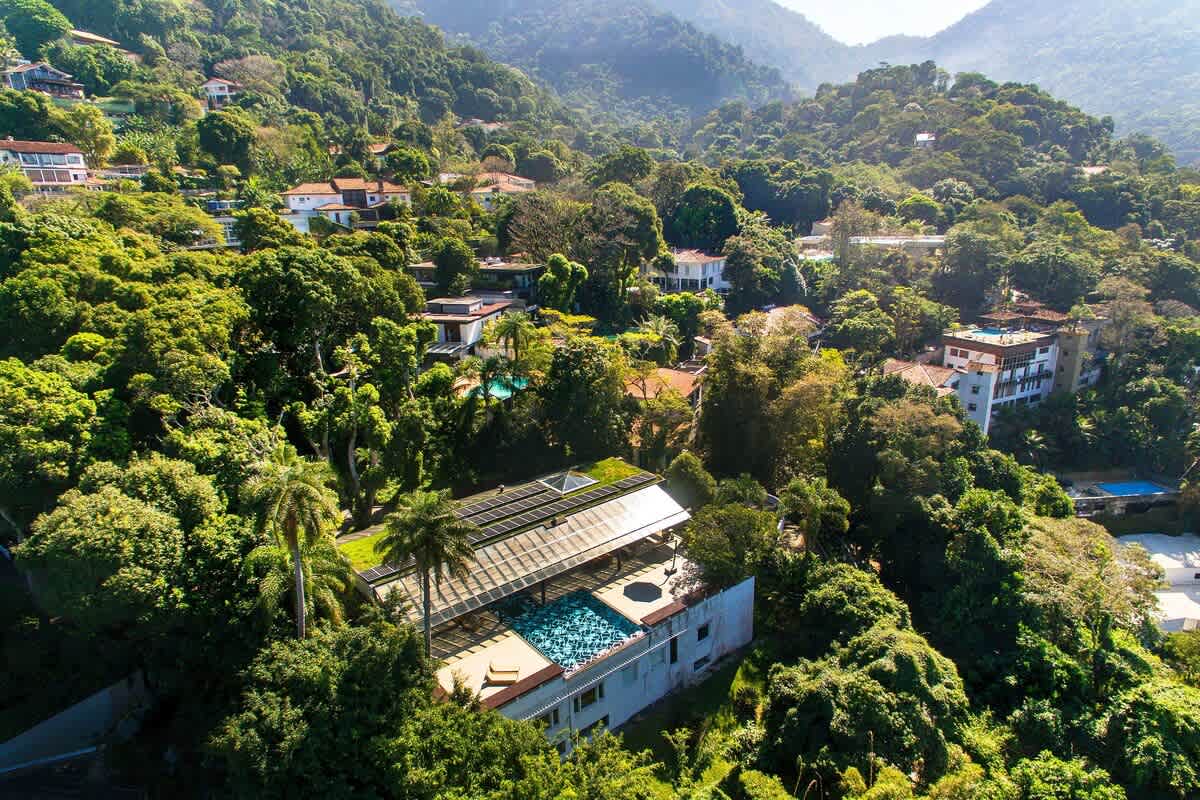
We run a five-suite villa with an infinity pool above São Conrado beach, and its rates and live availability are on the Art de Vivre booking page.
Book directThe garden
The Jardim Botânico do Rio de Janeiro sits at the foot of Corcovado, a few minutes from the Lagoa, with its main gate at Rua Jardim Botânico 1008. The cultivated arboretum covers about 54 hectares of avenues and plant beds, and behind it the Atlantic Forest climbs the hillside, with the Christ statue in view above the palm tops. Its living collections cover around 6,500 species, some of them endangered, and it has been protected as national heritage since 1937. Hundreds of thousands of people visit each year, and the long shaded avenues give everyone room.
From the villa it is a 15 to 20 minute drive through the Zuzu Angel tunnel and Gávea. The garden has no car park of its own, so the easiest arrival is a drop-off at the 1008 gate, where the ticket office and the museum are. Cars may also drive in at that gate to drop off anyone with limited mobility.
How it began
The garden dates from a decree of 13 June 1808, signed by the Prince Regent Dom João, later King João VI, in the same year the Portuguese court arrived in Rio. The idea was a garden to acclimatise spices from the East Indies, such as nutmeg, cinnamon and black pepper, on land taken from the old Engenho da Lagoa sugar mill, beside a new gunpowder factory.
By October 1808 it had become the Real Horto, the royal garden, and it opened to the public in 1822. The powder factory stopped work in 1826 and moved away, and its stone ruins are still inside the garden; today the children's playground sits among them. The Casa dos Pilões, kept as an archaeological site, preserves some of the factory's works.
Since 1998 the garden has been run as the Instituto de Pesquisas Jardim Botânico, a federal research institute. It keeps Brazil's largest herbarium, with more than 800,000 dried plant specimens, and a botanical library.
The Palma Mater and the avenue of palms
The garden's emblem is the imperial palm. Its story starts with the Palma Mater, a seedling that came from the Pamplemousses garden on Mauritius and which, tradition says, Dom João planted himself in 1809. It grew to 38.7 metres before lightning brought it down in 1972, and another palm, the Palma Filia, was planted in its place.
The royal planting is probably a later story. The scene was set down by João Barbosa Rodrigues, director from 1890 to 1909, in a book of 1894, and a 2023 article in the botanical journal Rodriguésia argues that the prince planting it with his own hands is unlikely, a tradition shaped in the first years of the Republic.
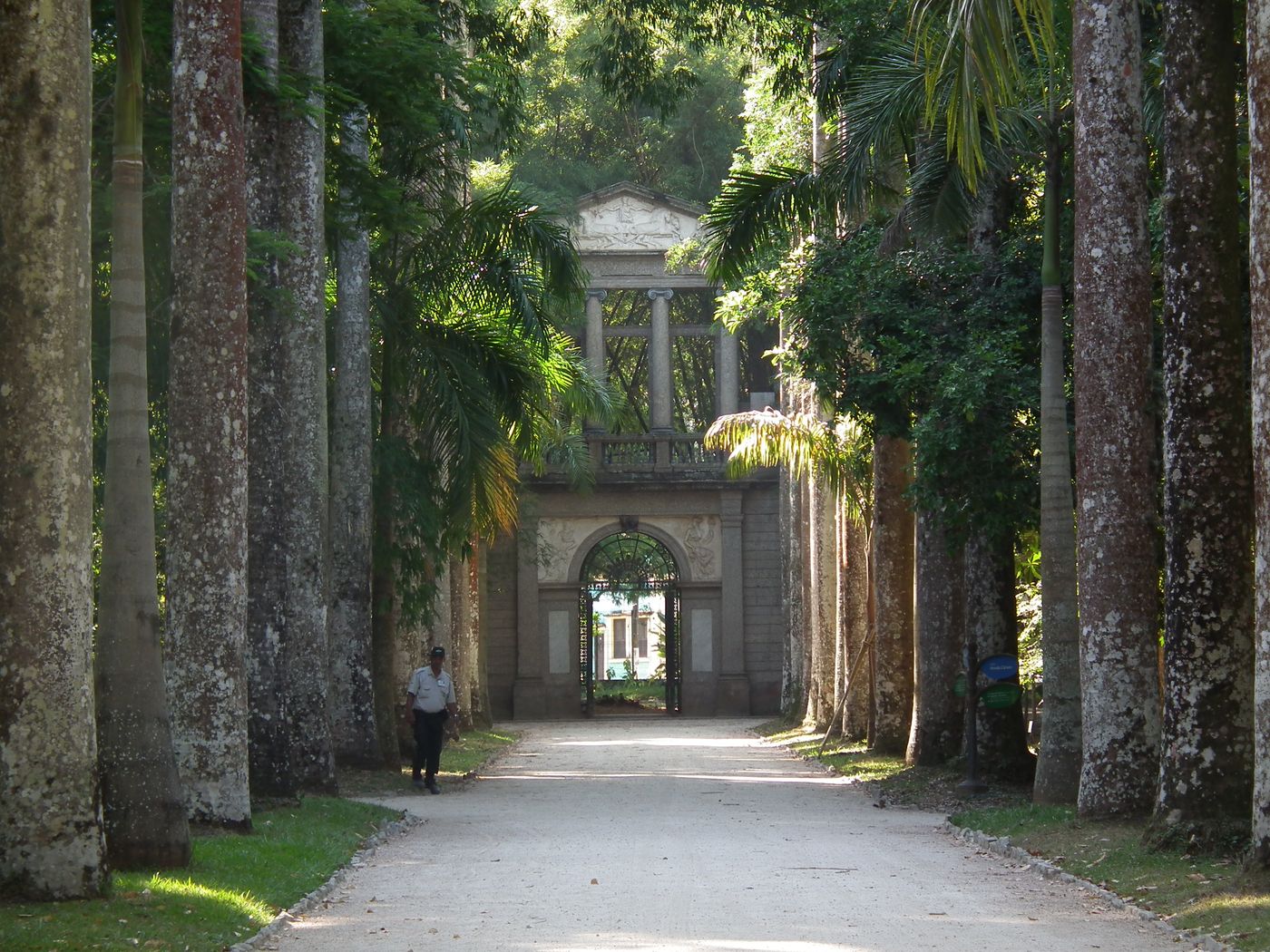
The avenue named after Barbosa Rodrigues leads in from the entrance as a straight line of imperial palms, planted in 1842: well over a hundred trees along about three-quarters of a kilometre. It is the garden's best-known view and the place for the group photo. A self-guided palm trail, with 21 stops, takes about an hour and a half.
Orchids, bromeliads and carnivorous plants
The orchid house, the Orquidário, holds more than 700 species of orchid in about 2,000 pots. It was built in the late 19th century and restored in 1998, and it stands on the Horto side of the arboretum, a good turning point for the walk.
The Bromeliário gathers about 1,700 bromeliads, the cup-shaped plants that grow on branches all through the Atlantic Forest, and a separate greenhouse is given over to carnivorous plants. The Jardim Sensorial, opened in 1995, is planted for touch and smell, with labels in braille.
The Japanese garden and Lago Frei Leandro
The Japanese garden began in 1935 with a gift of 65 plant species typical of Japan and was reopened in 1995, with carp in its ponds. Lago Frei Leandro, named after Frei Leandro do Santíssimo Sacramento, the director from 1824 to 1829, is the garden's showpiece pond, with giant Victoria water lilies and smaller water lilies on the surface and herons fishing along the edge.
Look out too for the statues of Echo and Narcissus by Mestre Valentim, and the stone portal of the old Academy of Fine Arts, designed by Grandjean de Montigny. The central cast-iron fountain was made in England and stood in Lapa until it was moved here after the 1905 reform of the Passeio Público.
Birds and monkeys
The garden is one of the easiest places in Rio to see wildlife. Around 140 bird species have been recorded here, many of them used to people, among them the channel-billed toucan, the rusty-margined guan, the slaty-breasted wood rail and the endangered white-necked hawk.
Tufted-ear marmosets and capuchin monkeys are often seen in the trees. Start early, walk slowly and keep an eye on the branches above the avenues. Feeding any animal is against the garden's rules, and pets are not allowed in.
The museum
Just inside the main gate, the Museu do Jardim Botânico opened in March 2024 in an early 20th-century house that once held the Museu do Meio Ambiente, restored with funding from Shell Brasil. It introduces Brazilian plants and the science behind them, and its temporary shows, on subjects such as Brazil's forests and savannas, change through the year.
Entry is free with a ticket from the online ticket site, and the museum opens Thursday to Tuesday from 10 am to 6 pm, last entry 5 pm. It has tactile floors and maps, a model of the building to touch, and a web app with texts in Portuguese, English and Spanish, Brazilian Sign Language videos and audio description.
Tickets and opening hours
The arboretum opens Thursday to Tuesday from 8 am to 5 pm, and on Wednesdays from 11 am to 5 pm, after the morning's maintenance. On 24 and 31 December it closes at 2 pm, and it shuts on Christmas Day and New Year's Day.
In 2026 a ticket cost R$ 80 for foreign visitors and R$ 40 for residents of Brazil, with children up to five free and half price for over-60s. Buy online at jbrj.eleventickets.com with a credit card or PIX, since the ticket office takes only cash and PIX, Brazil's instant-payment system. Prices change, so check before you go.
Besides the main gate at Rua Jardim Botânico 1008, there are entrances at Rua Jardim Botânico 920 (weekends and holidays only), Rua Pacheco Leão 101, and Rua Pacheco Leão 915, which only admits visitors who bought online. If you come by car without a driver, the Jockey Club car park opposite, at Rua Jardim Botânico 1003, gives a discount with a stamp from the ticket office.
Planning the visit
Allow two to three hours; the garden's own self-guided themed trails take between an hour and a half and two and a half hours each. In mid-2026 the restaurant and cafés inside were closed while new operators were chosen, and eating is allowed only at the tables by the children's playground, so have breakfast before you go and plan lunch for afterwards. Bring water, sunscreen and insect repellent. Light rain is no reason to cancel, since the museum and the greenhouses are under cover, and our rainy-day guide has more ideas for wet weather.
A good first loop takes in most of the highlights. Walk in along the palm avenue, turn off to Lago Frei Leandro, carry on west to the orchid house, then come back east past the Japanese garden to the museum by the main gate.
For grandparents or small children, the electric carts are the easy way round. A shared shuttle with stops runs every 15 minutes from 9 am to 4 pm (from 11 am on Wednesdays) at R$ 39 a person, and a private cart for up to seven costs R$ 261 for 30 minutes or R$ 392 for an hour, entry not included. Cart tickets are sold for cash at the ticket office, or online only to holders of a Brazilian CPF number, so bring reais. Wheelchairs can be requested from the visitor centre in advance.
Guided history walks run most days at 10 am and 2 pm, except Fridays, when free themed walks take their place, and night walks of about an hour and a half run on set dates. The garden pairs well with the Lagoa, a few minutes away, or with Parque Lage, a short drive away. For lunch afterwards, our Gávea guide is a good place to start.
Questions
How much is a ticket to Rio's Botanical Garden?
In 2026 a ticket cost R$ 80 for foreign visitors and R$ 40 for Brazil residents, with children up to five free and half price for over-60s. Buy online at jbrj.eleventickets.com; the ticket office takes only cash and PIX.
What time does the Jardim Botânico open?
The arboretum opens Thursday to Tuesday from 8 am to 5 pm and on Wednesdays from 11 am to 5 pm. It closes at 2 pm on 24 and 31 December and is shut on 25 December and 1 January.
How long do you need at the Rio Botanical Garden?
Two to three hours covers the palm avenue, the orchid house, the Japanese garden and Lago Frei Leandro. The garden's self-guided themed trails take one and a half to two and a half hours each.
Can you see monkeys at the Rio Botanical Garden?
Yes. Tufted-ear marmosets and capuchin monkeys are often seen, and around 140 bird species have been recorded, including the channel-billed toucan. Feeding the animals is not allowed.
Is there a café inside the Jardim Botânico?
In mid-2026 the restaurant and cafés inside were closed while new operators were chosen. Eating is allowed only at the tables by the children's playground, so check the official site for reopening news.
The Botanical Garden is a short drive from the villa, and Art de Vivre's driver can drop you at the main gate and collect you after lunch, so book the villa direct with Art de Vivre and keep a morning free for it.
Sources
Facts on this page were checked against these sources in October 2026. Opening hours and prices change: confirm before you go.
- Jardim Botânico do Rio de Janeiro (Wikipédia)
- Autoestrada Lagoa-Barra (Wikipédia)
- Rio de Janeiro Botanical Garden (Wikipedia)
- Ingressos (JBRJ, updated April 2026)
- Horários (JBRJ)
- Perguntas frequentes (JBRJ, updated July 2025)
- Conveniências (JBRJ, updated June 2026)
- Normas de visitação (JBRJ, updated June 2026)
- Visitas guiadas a pé e visitas temáticas (JBRJ, updated July 2026)
- Carros elétricos (JBRJ, updated July 2026)
- Museu do Jardim Botânico: funcionamento (JBRJ)
- Museu do Jardim Botânico destaca papel da ciência ante crise ecológica (Agência Brasil, March 2024)
- Allegory of the palma mater: an invented tradition (Rodriguésia, 2023)
- Jardim Botânico (Time Out Rio)
- Museu do Jardim Botânico (JBRJ)