Start with what is behind you
Most descriptions of a Rio view begin with the sea. Here you should turn round first, because the thing that makes this outlook unusual is at your back.
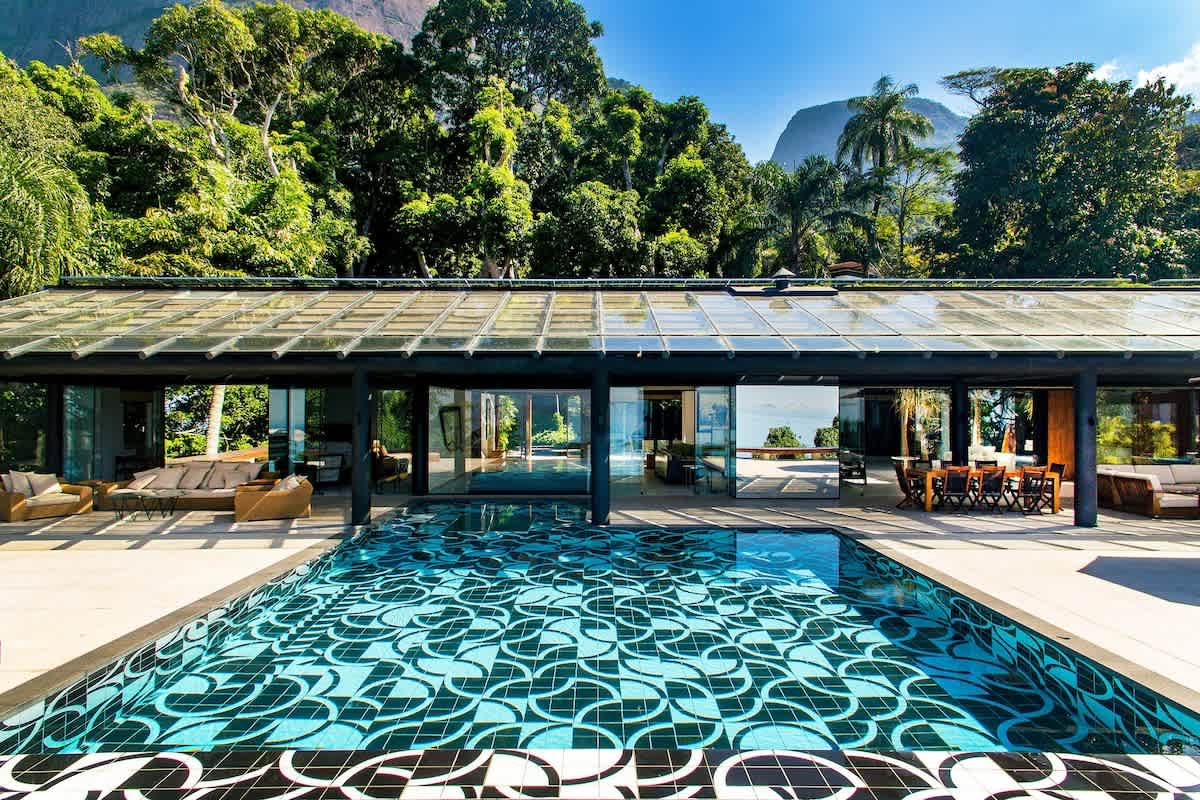
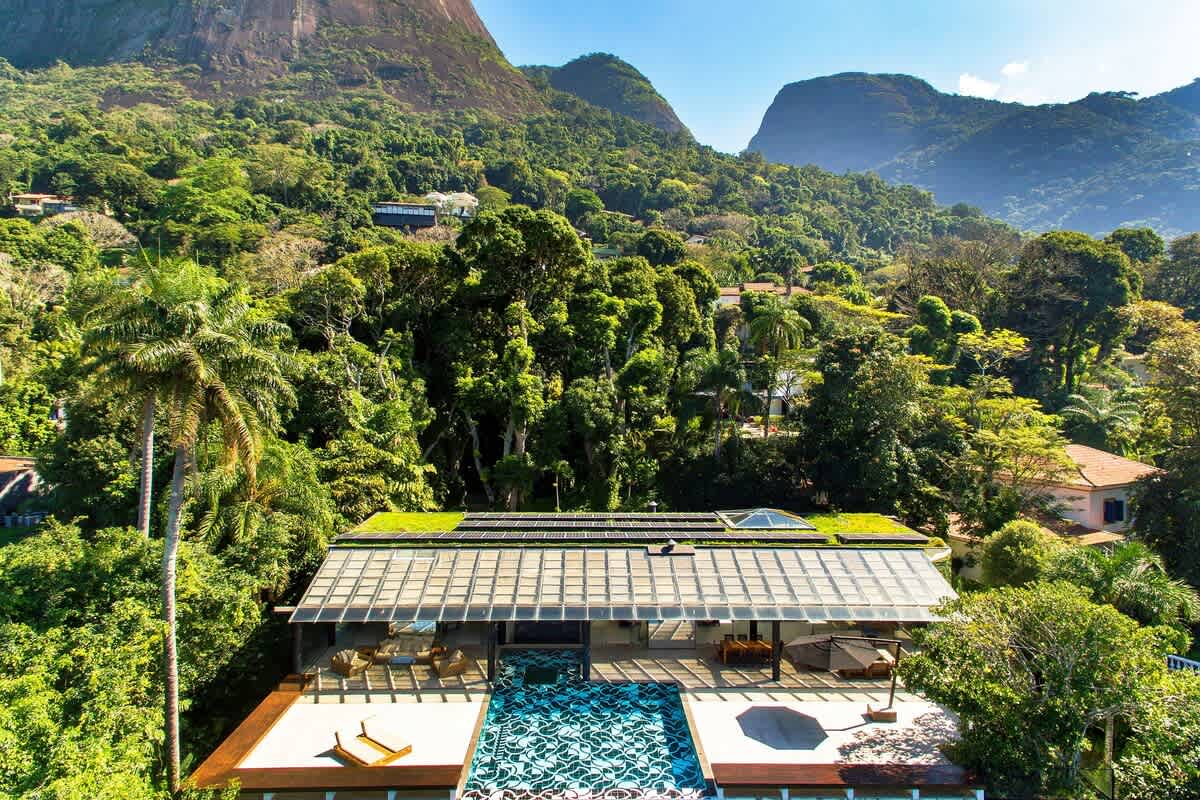
Directly behind the house stands Pedra da Gávea — a granite monolith, one of the largest anywhere on a coast, with a flat, sheer face that changes character with the weather. In clear morning light it is grey and precise, edge visible against the sky. By mid-afternoon it is warmer and less legible. When cloud comes in off the sea it disappears entirely and then reassembles an hour later, which is the single most theatrical thing the view does.
Around and below it is forest — Parque Nacional da Tijuca, which wraps the whole back of the neighbourhood. That is where the cooler air on this terrace comes from, and the birds, and the small monkeys that use the wall at the edge of the garden as a road.
Then the ground in front
Looking out and down, the first thing is green, and it surprises people who expected buildings: several hundred metres of fairway. That is the Gávea Golf & Country Club, laid out on the floor of the valley in the 1920s, which is the reason nothing was ever built between this hillside and the sand. The history of that accident is worth knowing.
Beyond the grass is São Conrado Beach — a wide arc of sand with the surf breaking along it, kiosks on the promenade, the calm end to the east and the swell picking up to the west. From up here you can read the sea state before you go down, which is more useful than it sounds.
Then the Atlantic, filling the rest of it. On the right, the coast runs west and ends in a headland of cliffs and houses: that is Joá, with the Joatinga cove hidden on its far side. On the left, the cliff road curls east out of sight toward Vidigal and Leblon.
The traffic in the air
The other thing in the view moves. Through the afternoon, coloured wings come over the ridge behind the house, bank out over the hillside, and spiral down toward the sand — hang-gliders and paragliders off the ramp at Pedra Bonita, five hundred and twenty metres up on the ridge, landing at the western end of the beach.
You watch the whole descent from the terrace, which takes ten or fifteen minutes, and on a good day there is a wing in the air almost continuously. It is the detail nobody expects and everybody mentions. It is also bookable.
Lower down there are frigatebirds working the updraught along the cliff, and at some point in most stays a pair of toucans crosses the garden, which reliably stops a conversation.
How it behaves across a day
Early morning is the clearest and the flattest — sea like a plate, the rock sharp, the light coming from the east along the coast so the whole view is lit from the side. This is when the view is at its most precise, and it is the hour photographers ask for.
By late morning the sea has picked up texture and the light has gone overhead and slightly harsh. Midday is not the view's best hour, which is convenient, because it is the hour to be in the water rather than looking at it.
From about four the whole thing improves steadily. The sun moves west along the coast rather than setting into the sea in front of you, so what you get is a long raking light down the length of the beach, the granite behind the house warming up, and the water going from bright to deep blue to almost black.
Then the switch. Rio's dusk is short — twenty minutes, not an hour — and afterwards the coast becomes a line of lights running east toward Leblon, with the beach dark in between. The rock behind the house becomes a shape rather than a surface. This is the hour the terrace is at its best, and it is when everybody sits down.
And the weather, which is part of it
In summer, storms are part of the view rather than an interruption. You watch them arrive along the coast from the west, over Joá, for maybe twenty minutes before they reach you — and then it is loud and vertical and over, and the air afterwards is the cleanest it gets. Anyone who has sat under the overhang and watched one come in stops resenting the rain.
In the cooler months, June to August, the view is at its most reliable: drier air, longer visibility, the horizon actually a line. Cooler water, but a clearer view.
Cloud on the rock is its own thing. Some mornings Pedra da Gávea is simply not there, and the house feels like it is on a coast with nothing behind it. Then it comes back. Guests who stay a week see this three or four times and it never becomes ordinary. When to visit covers the seasons properly.
The reason any of this matters is that a view you look at once is a photograph, and a view that changes is a reason to stay in. This one is the second kind, which is the honest argument for a house with a view rather than a room with one.
Ask us and we'll send photographs taken from the terrace at eye level, morning and evening, so you can judge the view rather than take our word for it.